


The date should leave room for the rest of your stay. Ang Thong takes a substantial day away from the hotel, and the friends sharing that day may want different levels of activity. A useful booking fits your arrival, leaves the preceding evening manageable and gives you a realistic plan for dinner afterward.
Count the whole day, including the hotel transfers
A boat departure time is only one part of the commitment. One currently published large-boat itinerary, Blue Stars Kayaking’s, starts with hotel pickup around 7 a.m., leaves Nathon at 8 a.m. and returns to the hotel around 6 p.m. That example occupies roughly eleven hours. Another boat may use different times, so I would compare the pickup-to-drop-off window before deciding how much else belongs on that date.
For friends, the early start has a shared cost. Someone has to arrange breakfast, everyone needs to be ready for the transfer, and a slow morning is no longer an option. A hotel breakfast buffet included in your rate may have little value that day if pickup happens before it opens. An early breakfast box is useful only when the hotel can arrange one at the time you actually need it.
The return also matters. A pier arrival does not mean you are already showered and ready for a restaurant across the island. I would keep the boat-day dinner near the hotel and choose somewhere the group can visit without a tightly timed reservation. Friends who still have energy can extend the evening; anyone who wants to eat and sleep can do that without changing everyone else’s plans.
This is why I would reserve a celebration dinner for another night. A birthday booking with a deposit or a tasting menu has a fixed start. The boat day has an estimated finish, followed by the transfer and whatever time the group needs to get ready. Keeping those two occasions separate gives the dinner its own evening instead of making it dependent on the return journey.
A late arrival changes the first morning
The first full day can work when you reach your hotel early enough to settle in and sleep normally. It is less appealing after a late flight, a long ferry connection or an arrival when the group still needs dinner. The calendar might show a free morning, but the available sleeping hours tell you whether that morning is useful for an offshore excursion.
On a five-night stay, my preferred arrangement would be a quiet arrival evening, a first full day on Samui and Ang Thong on the next day. That first island day can include checking the pickup location and deciding what to take, without turning the entire day into preparation. It also gives friends time to adjust to each other’s pace before spending a long day together on a boat.
A three-night stay creates a different problem because there may be only two full days. If Ang Thong is the main reason for visiting Samui and the arrival is settled, the first full day gives it the better chance. If arrival runs late, choosing the second day means accepting that a cancellation could leave no replacement date. That may still be a reasonable choice, but it affects what you should pay and how much of the trip depends on sailing.
Room location matters most when it changes the morning handoff. The exact property name, entrance and meeting point are more useful than a general promise of “hotel pickup.” For a villa or a property on a small access road, I would ask where the vehicle will wait and how the group reaches that point. The answer should be clear before the evening when everyone wants to stop planning and go to bed.
Check the park calendar before choosing a sailing date
Mu Ko Ang Thong has a scheduled annual closure listed for November 1 through December 15, covering tourist sites and accommodations. A Samui hotel stay during that period can still be enjoyable, but it needs an on-island plan. Moving the boat booking by a day within the closure does not solve the access problem.
I would check this before making Ang Thong the centerpiece of a November or early-December trip. An available date on a sales calendar is not enough to establish that the park will admit visitors. The park’s current access status and the operator’s actual route need to agree. A sailing somewhere else may be an alternative outing, but its stops should be named so the group knows what it is buying.
For dates around the end of a closure, the published calendar is a starting point rather than a promise that every service resumes immediately. A group booking flights specifically to see the park should get confirmation of access for the intended date. Friends who are mainly coming for Samui’s beaches have more freedom to keep the offshore day optional.
| Full days | A workable arrangement | The trade-off |
|---|---|---|
| Two | First day after a rested arrival, if Ang Thong is the priority. | A late arrival may make the second day more comfortable, with no later sailing opportunity. |
| Three | Second day, with the final day kept locally flexible. | A fixed event on the final day removes that flexibility. |
| Four or five | Second or third day, between quieter evenings. | Choose around the group’s plans and the operator’s available departures. |
| Six or more | A suitable departure once the short-range marine picture is clearer. | Waiting still leaves you dependent on seats and the chosen boat’s schedule. |
Use the marine forecast when it can inform the decision
A weather app showing rain over Samui does not describe the entire crossing. Marine information includes wind, wave conditions and thunderstorms, and the forecast has an issue time and a period it covers. I would use the Gulf shipping forecast close to the outing, together with any current warning and the operator’s update. A screenshot saved weeks earlier tells you little about that particular sailing.
The sea can be more difficult in a thunderstorm than the general wave description suggests. That is a reason to let the captain and relevant authorities make the operating decision, rather than using one number as a personal threshold. A larger boat may offer more space, but its size does not remove the need for suitable conditions.
The useful question for a booking is what happens if the operator changes the route or cancels. A changed stop, a shortened trip and a canceled sailing are different outcomes. Knowing the terms in advance helps the friends paying together decide whether a replacement date works, or whether they prefer to spend the day on Samui. A later vacancy in the itinerary creates an opportunity to move; it does not guarantee seats or better weather.
Sharing the trip does not require the same activity at every stop
Friends can want Ang Thong for different reasons. One may be interested in paddling, another in the viewpoints, and another in being around the islands without an ambitious climb. Some published itineraries provide a choice at a stop, including time on the beach. That makes the detailed program worth reading before treating the outing as one uniform activity level.
I would discuss the demanding parts before booking. A viewpoint climb, time in the water and getting between a boat and shore can matter to someone with limited mobility or low confidence swimming. The operator needs to know about those requirements when it can still explain the boarding method and available alternatives. Waiting until the group is on board leaves much less room to change the plan.
Where the program allows people to choose separately, a meeting point and return time can keep the day sociable without everyone doing the same thing. If the excursion requires the group to stay together throughout, that is a different fit. The friend who would rather rest should be able to say so while you are comparing trips, when a gentler route or an on-island day is still an easy choice.
The following morning can absorb some of the physical effort. A leisurely breakfast and time at the hotel are easier to adjust than another early departure. Our Ang Thong kayaking guide helps with the activity choice, while the boat-format comparison addresses a separate decision about the journey itself.
Choose a hotel for the evenings you will actually have
A convenient pickup is one morning of the stay. The hotel also shapes the evenings before and after it, and the days you remain on Samui. I would give nearby food and a room arrangement that suits the friends more weight than shaving a few minutes off one transfer. Separate beds, space to get ready and a location everyone is happy returning to have repeated value.
For a group planning several dinners out, a base with restaurants within a comfortable walk can reduce the need to negotiate rides every evening. A quieter resort can work better for friends who want to spend more time at the property, provided its dining hours and prices fit the group. The Chaweng versus Bophut comparison is useful for that broader choice; the hotel pickup guide deals with the transfer question.
I would usually keep the same hotel through the boat day. Checking out before pickup creates a luggage problem, and changing hotels afterward adds another handoff when the group may be ready to stop moving. If a split stay is already part of the trip, placing the excursion within one settled block is easier than using it as the bridge between properties.
A departure flight or ferry deserves its own transfer plan. Scheduling Ang Thong on that date makes the onward journey dependent on the boat’s return, even when the advertised times seem to fit. A full day spent offshore is a poor place to put a connection you cannot afford to miss.
The cancellation deadline belongs in the shared plan
Customer cancellation and an operator stopping a trip for weather can have different terms. Blue Stars’ published policy, for example, uses separate customer-cancellation windows at 48 and 24 hours, while its operator-cancellation provision offers a refund when a weather or technical cancellation cannot be moved within the stay. That is one operator’s policy, not a rule for all Ang Thong tickets.
I would save the terms attached to the actual booking and put the decision deadline where both friends can see it. The person holding the reservation should know how to contact the operator and who is receiving updates. If one friend decides to stay behind, the group needs to know whether that changes the price or counts as a late cancellation for that person.
A deposit also affects the budget when a replacement excursion is being considered. A refund promised after cancellation may not reach the card before the group pays for something else. Agreeing who pays the original booking and how any refund will be divided avoids a small administrative problem taking over the last evening of the trip.
Scheduling sources, safety details and image rights
- Checked October 12, 2026. TAT seasonal-opening notice links to the National Park Office’s published national-park closure table. Mu Ko Ang Thong row 31 lists tourist sites and accommodations, annual closure November 1–December 15. Park notices and emergency restrictions may change actual access.
- Thai Meteorological Department shipping forecast and shipping, ocean-wave and wave-risk tools: used to verify the marine-information channels and thunderstorm caution. No single forecast’s wave figures are presented as a permanent sailing rule. The issue time and validity period must match the intended outing.
- Blue Stars actual tour program: illustrative 7 a.m. pickup, 8 a.m. Nathon departure and hotel return around 6 p.m.; activities and transfer timing are operator-specific. Blue Stars cancellation policy: customer cancellation more than 48 hours before departure fully refunded, under 48 hours charged 25%, under 24 hours charged 100%; operator weather/technical cancellation refunded if it cannot be rescheduled during the stay. Exact-boundary handling and the terms of the chosen booking require confirmation.
- Safety: follow the captain’s and park staff’s directions, use the supplied life jacket as instructed, and stay out of water or activities closed by the crew. Viewpoint routes can involve steep climbing. Boarding accessibility, swimming requirements and any medical restrictions need an answer from the selected operator; this page does not establish accessibility for every boat or route.
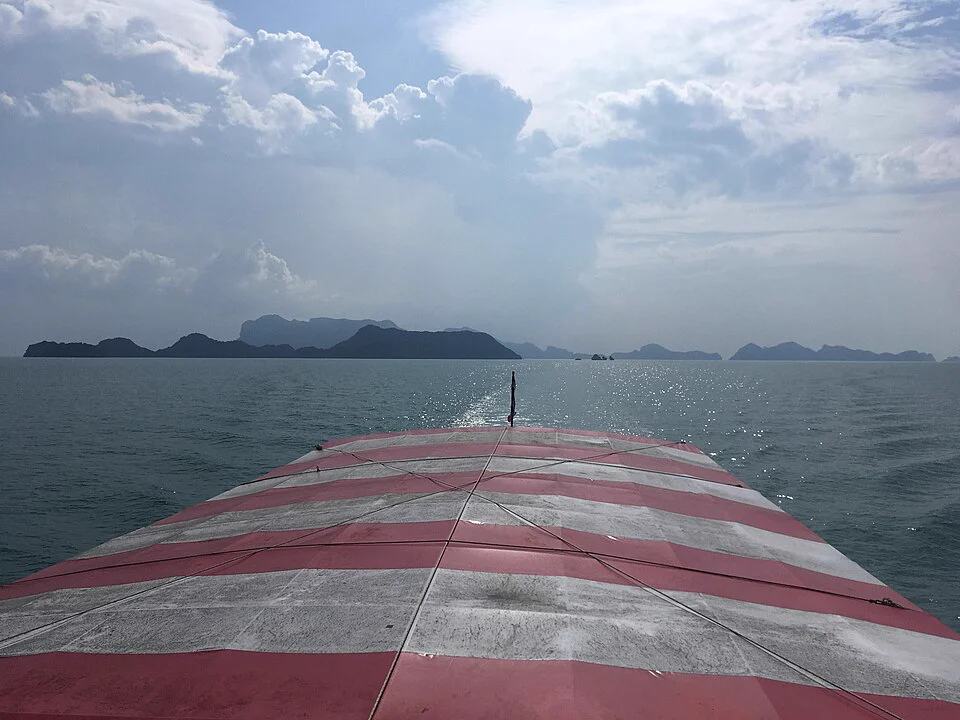
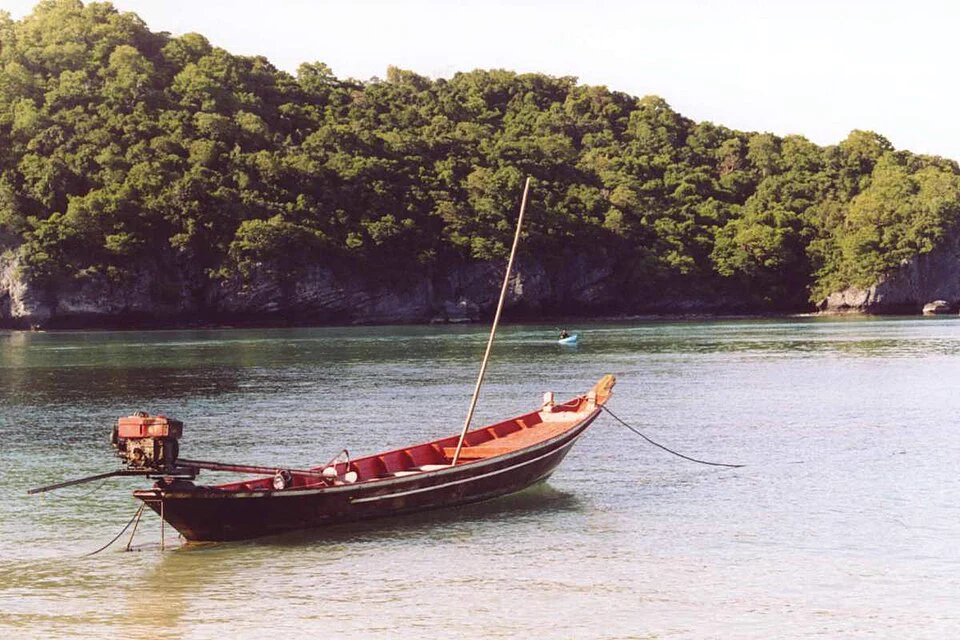
- Both photographs depict Ang Thong and were visually checked after downloading the local bytes. Figure credits contain author, capture date, exact Commons file, selected license and crop/conversion terms. They document scenery in 2018 and 2002; neither establishes a current operator’s vessel or conditions on a future sailing.