
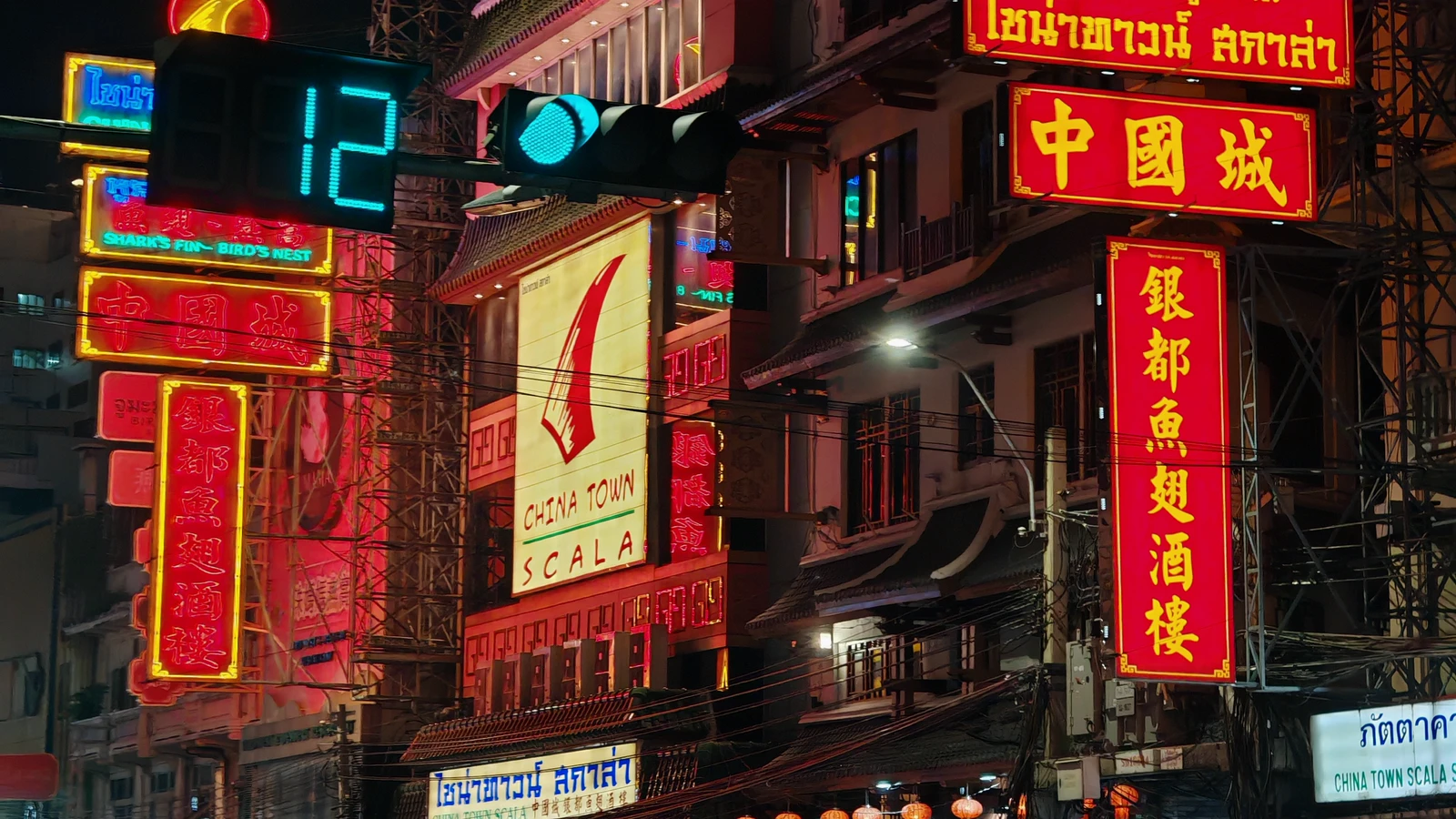
The choice turns on what you mean by “Chinatown.” If you mainly want Yaowarat’s food streets after dark, it can follow a focused temple morning. If you want market lanes, Chinese shrines, Talat Noi and time to notice the neighbourhood between meals, give it daylight of its own. Both areas are close enough to connect by rail or road, but proximity on a map does not make the combined day short: the Palace grounds, temple courtyards and Chinatown lanes all involve standing and walking.
The official Grand Palace information distinguishes its 4:30 p.m. closing time from the 3:30 p.m. ticket cutoff; the FAQ says it is open daily, but the schedules page can list date-specific changes. Plan admission around the earlier cutoff and confirm the date before leaving. Wat Pho lists hours of 8 a.m.–7:30 p.m. Its later closing time gives flexibility, but it does not mean you should push the Palace visit into the afternoon. Yaowarat’s food-stall activity is more naturally an evening plan, while shops, lanes and heritage stops reward a separate daytime window. (Current hours and route details are linked in Sources below.)
Choose by the Chinatown experience you actually want
Choose one day if your Chinatown brief is specific: reach Yaowarat around dinner, sample a few dishes, walk a manageable stretch of the main road and nearby lanes, then head back. This works especially well when the Grand Palace and Wat Pho are the priorities and you are content for Chinatown to be a food-focused evening rather than a complete district visit. Set a return time before you start eating if your hotel is far away or your next morning is early.
Choose separate blocks if you have a list that includes Wat Traimit, Chinese religious sites, market browsing or Talat Noi’s backstreets, or if wandering and photography are part of the point. Daylight helps with signs, shopfronts and the small details that disappear in a dinner-only visit. A split also lets you shift Chinatown to a different day if the Grand Palace is unexpectedly closed or the heat makes a full walking day unappealing.
Think about your appetite for crowds, too. Yaowarat’s busiest food period is part of its appeal for some visitors and exactly the wrong setting for others. If you dislike queues, narrow pavements and slow movement, separate days give you more control over when to arrive and where to eat. They do not guarantee a quiet Chinatown; they simply let you avoid stacking temple crowds and evening street crowds into one continuous outing.
A combined day needs a deliberately light middle
Start at the Grand Palace near opening, after checking its schedule and visitor requirements. Allow enough time for the complex itself rather than treating it as a quick photo stop; then decide whether Wat Pho is still a priority. These are substantial visits even though they sit near each other. Add another temple only if you are willing to shorten one of them, and check that site’s current access separately.
Build a proper midday pause into the plan. Have lunch somewhere with seating, drink water and get out of direct sun. Keep the next activity optional: a short riverside stop may be pleasant, but there is little value in forcing another walk because it appears nearby. If you return to your hotel, compare the door-to-door trip with staying in the area. A cross-city round trip can consume the rest you hoped to gain.
For the transfer east, BEM’s Blue Line map lists Sanam Chai, Sam Yot and Wat Mangkon in sequence. Sanam Chai serves the Grand Palace and Wat Pho area; Wat Mangkon is the practical station for the Chinatown side. That makes the MRT a clear option when the day’s endpoints are near those stations, though you still need to walk between the sights and your station. Check service hours and your actual hotel connection before relying on a late train. A river boat or road transfer can fit better from a pier or a different final stop; traffic and waiting time make fixed journey estimates unreliable, so avoid booking dinner that assumes a precise arrival minute.
Arrive in Yaowarat with one simple plan: choose a stretch or a couple of food stops, leave room to browse, and decide in advance how late you are willing to stay. The district is more enjoyable when dinner is the evening’s main event. Trying to add several shrines and a long market circuit after a full temple morning makes the day’s last hours the least flexible.
Separate days work best when both districts matter
On a split itinerary, use one morning for the Grand Palace and Wat Pho, then let the rest of that day follow your energy and location. On another day, visit Chinatown in late afternoon, when you can see some of its daytime character and stay for dinner. This arrangement avoids the common compromise of arriving in Yaowarat tired and discovering that the browsing you wanted needs daylight.
If your schedule has no spare day, separate does not have to mean two full sightseeing days. Put the temples on a morning and reserve a later afternoon/evening on a different date for Chinatown. That short block is enough for a defined neighbourhood walk and meal without claiming to cover every lane. If you have only one available day, prioritize the district that matters more to you and keep the other to a small, realistic add-on.
A split makes particular sense for families with young children, anyone who needs regular sitting breaks, and travellers who find heat or long walks draining. The benefit is control over pace and a chance to return to the hotel before dinner. It is less compelling if the hotel is inconveniently far from both areas and each outing means a long commute. Use the base, not the district labels, to decide whether a midday return is sensible. For that location trade-off, compare Siam vs Old Town and Siam vs Riverside.
Use your hotel and transport plan as the tie-breaker
From an Old Town or riverside base, splitting can be convenient if you can return without a long detour; it may also be easy to stay nearby between the temple morning and dinner. From Siam or Sukhumvit, one continuous day can reduce repeated travel, but the ride back after dinner becomes part of the decision. Check the walk from the station to your hotel, the last train on your date and any interchange you need. A nearby BTS or MRT label does not describe the final walk through a large block or a deep soi. See near BTS vs deep in a soi for that last-leg question.
Do not choose a boat transfer simply because the route looks scenic. It is useful when a pier is already near your start or finish and the service timing suits your plan. If reaching the pier takes an extra taxi and a wait, the MRT may be simpler. Likewise, a road car can be comfortable in rain or for a group, but rush-hour congestion can erase the apparent time saving. Keep the transfer flexible and decide on the day from your actual location and weather.
Give Chinatown its own block if you want its daytime side
Separate days make sense when your Chinatown list includes market lanes, Chinese temples, Talat Noi or a slower photographic walk. Those plans compete with a full Grand Palace and Wat Pho visit for daylight. With a separate afternoon and evening, you can browse at your own pace and still stay for dinner without watching the clock.
I would also split the day if temple visits are a main reason for the trip, if you know heat makes your evenings miserable, or if you genuinely want to return to the hotel before going out again. A split is easier from a central base with straightforward connections; it is less appealing when it means repeating a long cross-city journey. For the hotel-location trade-off, see Siam vs Old Town and Siam vs Riverside.
When neither same-day nor a full split is right
Skip the long combination after a red-eye, on a day with a tight appointment, or when you have only one full Bangkok day and a competing priority. The red-eye arrival guide covers the recovery decision; if Ayutthaya is also on your shortlist, compare its time commitment in Bangkok in four days: is Ayutthaya worth a full day?.
Before booking this for your last night, check your flight time and airport transfer plan. A late dinner is a poor fit when you need an early departure, so use the Bangkok last-evening guide to choose a nearer, lower-effort option.
If you are staying in Sukhumvit, the ride back may be the deciding factor. Wat Mangkon is on the Blue Line, which continues toward Sukhumvit; from there, check the last-train timing for your date and whether your hotel needs another connection or a walk through a soi. Near BTS vs deep in a soi explains why that final leg matters after a late meal.
A quick decision rule
Combine the areas when your Old Town plan is limited to the Grand Palace and Wat Pho, your Chinatown plan is dinner plus a short walk, and you are comfortable being out for most of the day. Keep the afternoon open and travel between the areas by whichever route fits your final temple and current conditions.
Split them when you want Chinatown’s daytime lanes as well as dinner, when you prefer a hotel break, or when heat, mobility or crowd tolerance makes one long outing a poor fit. If you have to compress, choose a focused half-day in one area and a meal in the other rather than pretending you can see both comprehensively. Check date-specific Palace access and train service before committing; ticket sales end at 3:30 p.m. even though the official site lists a later overall closing time.
For other Bangkok day-planning decisions, browse the itinerary guides or start with the Bangkok destination guide.
Sources checked · 12 October 2026
Grand Palace — visitor information and dress code; Grand Palace — visitor FAQ; Grand Palace — date-specific schedules; Wat Pho — visitor plan and opening hours; BEM — MRT Blue Line map and operating hours; BEM — Sanam Chai station exits and nearby places; Tourism Authority of Thailand — Chinatown; Tourism Authority of Thailand — river and Yaowarat day/night context.