
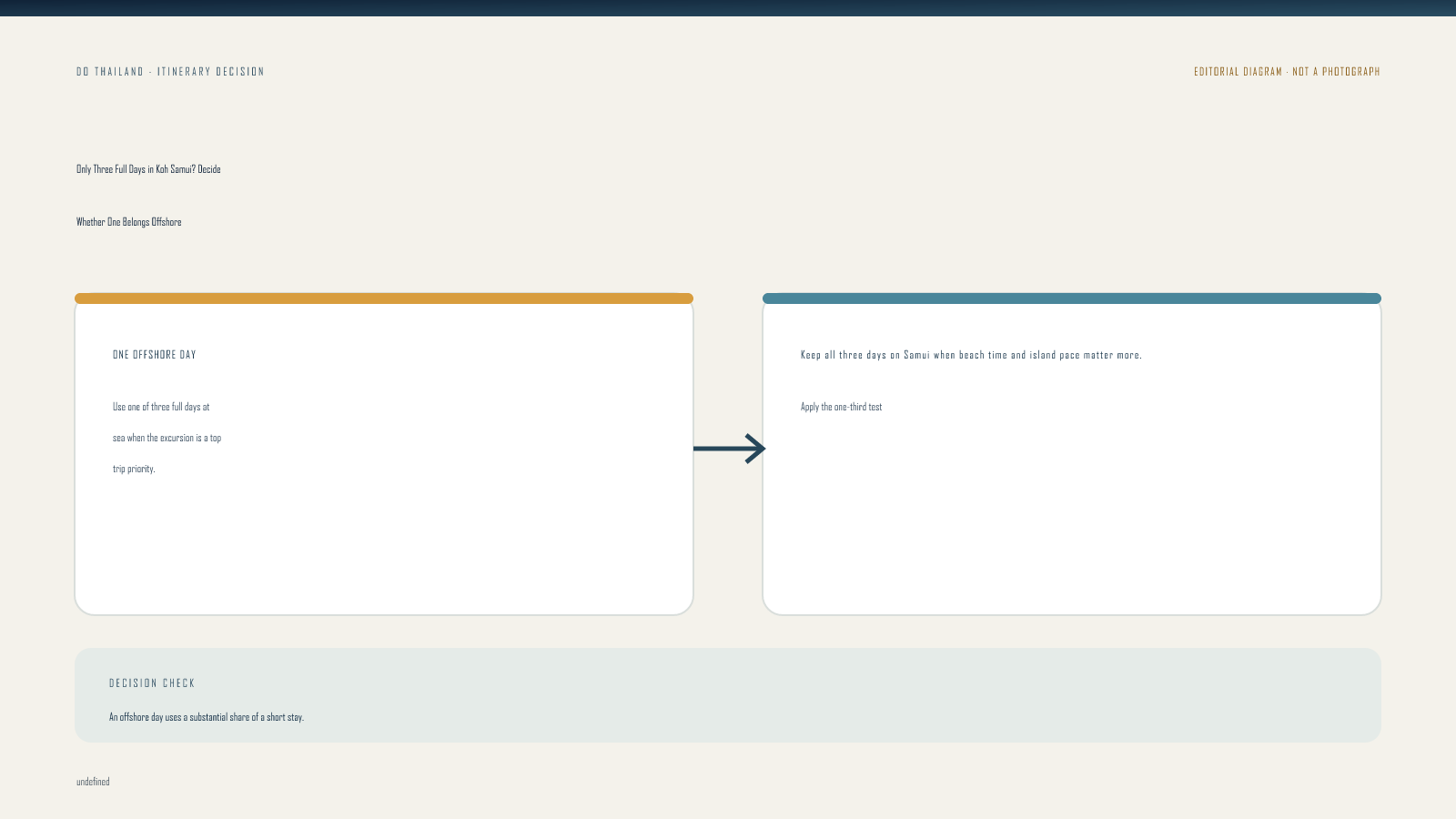
A three-day Samui itinerary is not mainly a question of how many attractions can fit on a map. It is a question of what deserves 33% of your usable trip.
Tourism Authority of Thailand currently describes Samui as much more than a launch point for other islands: Chaweng, Lamai and Taling Ngam are among its highlighted beaches, while Bo Phut, wellness, cooking, diving and other activities sit alongside the island's natural and cultural attractions. At the same time, TAT also treats Mu Ko Ang Thong as a legitimate day trip from Samui. Both choices are valid. With three days, however, you cannot treat them as cost-free additions.
Your orientation day: learn the base, use the beach you actually booked and discover what “easy dinner” means from your exact hotel.
Your highest-commitment day: offshore if the sea is a priority, otherwise your biggest on-island route.
Your correction day: spend it on the side of Samui your first two days proved you value most, rather than chasing a leftover checklist.
The one-third test
Before you reserve any full-day marine plan, finish this sentence: “I am happy to give one of my three full Samui days to this because…”
If the answer is specific—snorkelling is the trip priority, Ang Thong scenery is a must, or you have wanted a particular island day for years—the trade is coherent. If the answer is “it seems like the standard thing to do,” it is not yet strong enough.
TAT's own planning material shows both approaches. Its current four-day Ko Samui–Surat Thani planner gives Mu Ko Ang Thong a major place and separately uses an on-island day for Phra Yai, Hin Ta Hin Yai, Laem So and Lamai. A TAT southern-route collection also includes a three-day/two-night Samui route built partly around Ko Taen and Ko Madsum. The useful takeaway is not that either official route is compulsory. It is that an offshore day is a major allocation, not a small extra.
Choose one offshore day when it creates a different trip
An offshore day earns its space when it gives you something your remaining Samui days cannot realistically replace. The strongest cases are simple: you care deeply about marine scenery, snorkelling or an island landscape; you are comfortable losing most of a daylight block to the outing; and your other two days still cover the beach-town or resort rhythm you came to Samui for.
If you are deciding between the two classic bigger marine directions, the existing Koh Tao vs Ang Thong guide handles that choice. If Ang Thong is already the winner, whether to add kayaking is a narrower decision that should come later. If you want a less consuming sea day, compare the effort and time profile in Koh Tao vs a Pig Island half-day rather than automatically turning the middle of the trip into a full-day expedition.
The sequence matters. Decide whether a full offshore day belongs in the three-day budget first. Only then decide which marine experience and format fits it.
Plan A: One offshore day
Best for: travellers who would feel their Samui trip was incomplete without a substantial marine day.
Use Day 1 for your hotel area and a low-friction evening. Use the best suitable full day for the offshore plan. Keep the third day entirely on Samui, preferably with a different texture: inland scenery, temples, a second beach zone or a slower resort day.
Plan B: All three days on Samui
Best for: first-timers who value beach choice, food, relaxed evenings and flexibility more than one headline excursion.
Give each day a different radius instead of trying to circle the entire island daily: one hotel-area day, one purposeful cross-island or inland day, and one day built around whichever coast or neighbourhood you most want to repeat.
Keeping all three days on Samui is not the “less adventurous” option
Samui is large enough in practical terms that three on-island days can feel very different. A Chaweng or Lamai day has a different evening rhythm from Bophut or Maenam; a waterfall or interior route changes the pace again; and a deliberately slow beach/resort block often becomes the part people were hoping an island holiday would contain in the first place.
If you have not chosen a base yet, resolve that before the itinerary. Chaweng vs Bophut is fundamentally a nightlife-and-evening-convenience choice, while Maenam vs Lamai changes how much of the trip feels quiet and resort-led versus self-contained and walk-out friendly. If you are tempted to solve geography by changing hotels, read the one resort vs split-stay guide before adding a checkout to a three-day trip.
For an inland contrast, Na Muang independently vs a 4x4 safari format separates the transport/structure decision from the attraction itself. If what you really need by Day 3 is recovery rather than another route, massage vs a fuller spa day is a more honest use of the final block than forcing a final “must-see.”
A high-contrast day, marine scenery and a sense that the trip extended beyond Samui itself.
One third of your full-day capacity, plus a morning and return window that are less flexible than simply leaving your hotel when you want.
More control over pace, more room to repeat the beach or neighbourhood you actually like, and less pressure if you wake up tired or the weather looks uninviting.
You may leave without the “big sea day” that many travellers associate with a Gulf-island holiday. If that omission would bother you, the flexible plan is not automatically the better plan.
Do not assign the offshore day to a date too early
Build the trip with a marine slot, not a sacred “Tuesday boat day.” Mu Ko Ang Thong remains an actively managed national park—Thailand's Department of National Parks was publicly reporting visitor-service and safety work there in April 2026—but marine access and individual operator schedules can still depend on the conditions and rules applying to your travel date.
The practical move is to know which of your three days can swap. Keep one on-island plan that can move forward or back without wasting a reservation. Then recheck the official park/operator information and the forecast close to the date. Flexibility is useful only when the replacement day is already mentally chosen.
Your hotel location changes the cost of an offshore day
A full-day excursion takes longer than the hours advertised on a booking page. Your real day includes the first pickup, the return to your hotel and what remains of the evening. A pickup that looks harmless when browsing becomes more important when it is one of only three mornings.
Before committing, check the exact pickup assumptions for your hotel area. The tour-pickup hotel-location guide is useful here. It keeps you from choosing a hotel just for one excursion, but it also stops you from pretending every Samui address creates the same start and finish.
Arrival day should not carry this burden either. If you are flying or ferrying in, use the fly-in vs ferry-in hotel-base guide to protect the first evening. And if your arrival time is uncertain, the arrival-day activity vs flexible plan explains why a fixed major experience is usually a poor use of the first partial day.
Keep the itinerary lighter during daylight. Three dinners you enjoy in Chaweng, Lamai or Fisherman's Village may be more valuable to you than returning exhausted from a second ambitious day.
Count pool, beach and spa hours as real itinerary time. Do not pay for a resort you only see before breakfast and after dark.
Protect the offshore day, accept that it dominates one third of the trip, and make the other two days simpler rather than competing with it.
For women travelling solo or as a pair, the return matters as much as the outing
TAT currently advises extra care walking on beaches or swimming at night when alone, warns that motorbikes are involved in numerous accidents on Samui and recommends agreeing taxi or tuk-tuk fares before departure. Those are better planning inputs than vague labels such as “safe area.”
For a three-day trip, I would therefore favour an itinerary that gives you a clear return plan every evening. Check where the vehicle can actually drop you, whether the final approach to the hotel is comfortable after dark, and whether you will be trying to solve dinner after a long wet day. If you are not riding a scooter, do not compensate by cramming the timetable; choose fewer routes and make the transfers deliberate.
Three sample trip personalities
The first-timer who wants “a bit of everything”
Keep all three days on Samui. Use one day around your chosen base, one day for a purposeful island route or inland contrast, and one day for the coast or neighbourhood you most want to repeat. Add a shorter marine experience only if it clearly fits without taking over the trip.
The snorkelling-and-islands traveller
Use one full offshore day. Make it the centrepiece, not one item among ten. Keep the day before or after materially lighter so the trip still feels like a holiday rather than a sequence of departures.
The resort-led couple or friends trip
Usually keep all three days on Samui. If the hotel itself was a major purchase decision, count time using it. A sea day should replace resort hours only because you actively prefer the excursion.
The booking rule
Three full days means you can afford one major offshore day, not that you owe yourself one. Put it in the plan when it is a top-two priority. Otherwise, keep the three-day structure on Samui and let one of the days grow bigger only after you know your energy, weather and favourite part of the island.
If the bigger decision is still unresolved, start with the Koh Samui decision hub. For other complete trip structures, browse the Do Thailand itinerary guides.