
The resort is on the Mae Ping River in Chang Klan, on the Night Bazaar side of central Chiang Mai. It is not an Old City walk-out hotel. The property is roughly 4.5 kilometers from Chiang Mai International Airport; the resort describes its own airport drive as about 15 minutes and offers private transfers for a charge.
Those details make arrival relatively simple, but they do not make a city-focused day self-contained. A couple heading out to temples or Nimman should plan to arrange rides rather than assume they can wander back for a break between every stop.
This guide is for first-time U.S. travelers who want a comfortable base with a real resort component, but still want to see the city. It assumes two adults, four Chiang Mai nights after a longer Thailand trip, and a moderate pace: a few major cultural stops, one or two food-led evenings, and enough unscheduled time to enjoy the hotel.
It is not aimed at travelers who want to spend the whole trip at the pool, or at visitors who measure a good hotel by whether they can step outside into a dense café district.
The practical answer
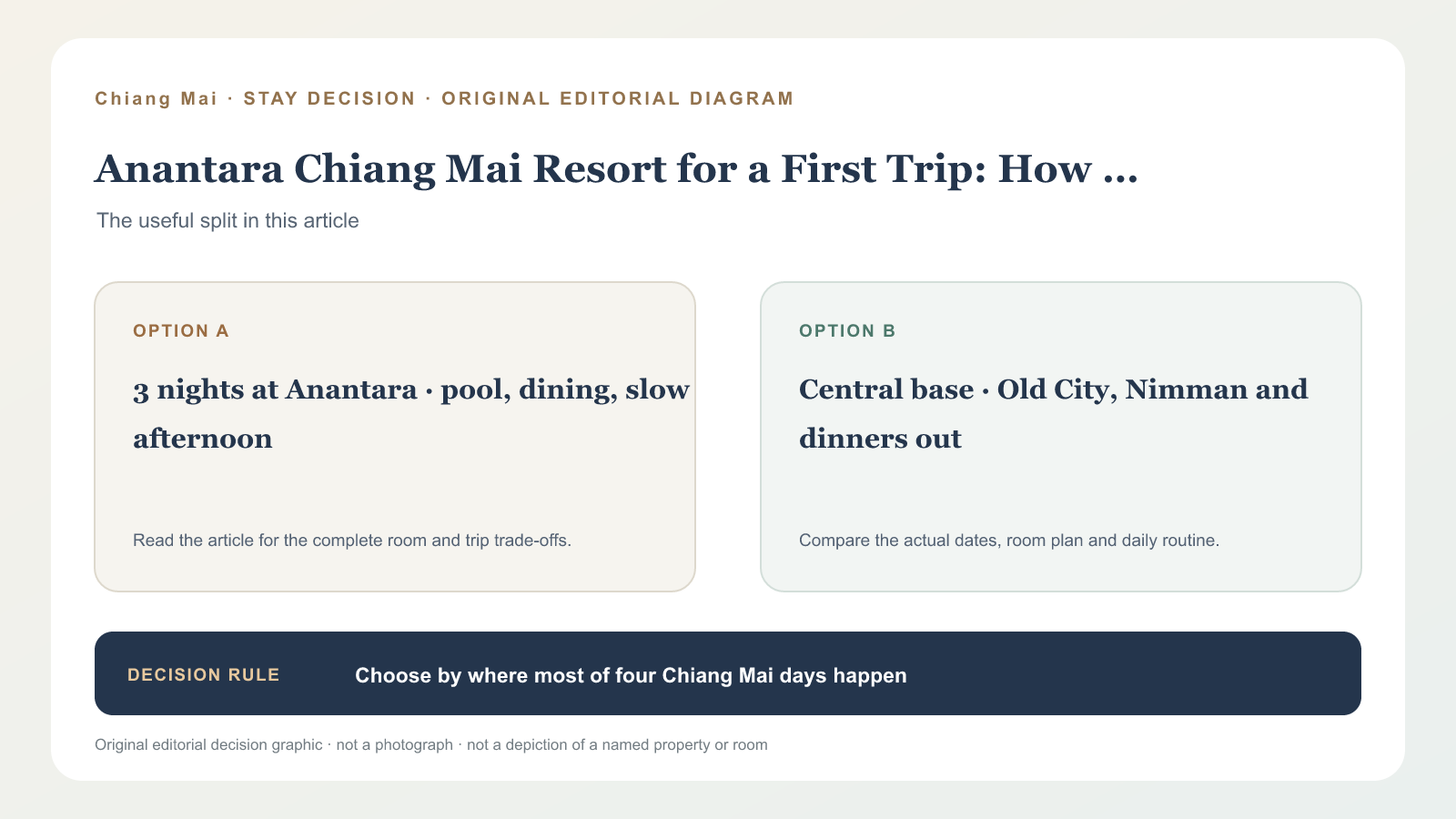
Book three nights here for a four-night Chiang Mai stay when you expect to use the property on at least one afternoon and one evening. That gives you two substantial city days and one arrival or departure day without turning every hour into a transfer. Choose four nights if you prefer a slower itinerary and will use the spa, pool, river cruise or on-property meals more than once. Choose a central hotel for all four nights if you expect to be out from breakfast through dinner on most days.
Riverside resort · Chiang Mai
Compare the same dates before choosing your base
Check the total for your exact nights and room category, then compare it with a central hotel. The value depends on how much resort time your itinerary leaves open.
What you are paying to have close at hand
Anantara Chiang Mai Resort has 52 rooms and 34 suites, with a separate serviced-suites building across the road. For this decision, keep the resort and serviced suites distinct: this article is about the riverside hotel rooms and suites, not the residence building.
The resort’s 34-meter pool sits beside the Mae Ping, and the property’s dining includes Bodhi Terrace and the historic 1921 House. Its private pier also makes the JAO Ping River Cruise an unusually easy activity to consider without first crossing the city to find a departure point.
That concentration of facilities matters most in the late afternoon. After a morning in the Old City, you can return for a swim, change for dinner, or make an evening around the river. It matters less if you leave after breakfast, stay out until late, and use the room only to sleep. The hotel does not need to replace Chiang Mai’s markets and neighborhoods; it needs to earn the hours you spend coming back to it.
Editorial fit for the first-trip couple described above
Scores are decision-fit judgments out of 10, based on published room and facility details and the itinerary trade-offs below; they are not guest ratings.
A 34-meter riverfront pool, spa and lawn yoga give a couple more than a room-only reason to return during daylight.
The entry Deluxe room is 50 m², accommodates two adults and offers a King or Twin setup, with a balcony or terrace and separate tub and shower.
Bodhi Terrace, the 1921 House venues and river cruises create different dinner or drinks plans without requiring a cross-town trip.
The riverfront position works as a base for city outings, but the hotel is not beside the Old City temples; rides add a step to spontaneous returns.
Three nights can leave two full sightseeing days and one protected hotel period, provided the couple does not schedule every meal elsewhere.
The hotel remains a capable room base, but the resort facilities contribute less when the itinerary keeps both guests away until bedtime.
Choose the room around the hour you will use it
The Deluxe Garden View and Deluxe River View rooms are both listed at 50 m² for up to two adults. The official room details show King or Twin bedding, and the categories share the same basic room scale. The main decision is the view from the private balcony or terrace, not a larger floor plan. Anantara’s current room information also lists a separate bathtub and rain shower in its Deluxe rooms.
Choose Garden View if the room is mainly a comfortable place to reset and you expect your best river views to come from the pool, Bodhi Terrace or a boat. Choose River View when you will use the balcony in the morning or at sunset and the quoted upgrade is acceptable for those private hours.
A view-facing room is easiest to justify on a three- or four-night stay, when there is time to sit outside more than once. On a two-night stop dominated by excursions, the same upgrade may buy a view you see mostly while passing through the room.
Suites change the question from view to separation and service. The resort lists suites from 105 to 150 m², with indoor and outdoor lounging and dining, garden or river views, and Kasara privileges. That additional living space is useful if one partner works, wakes earlier, or wants a distinct place to read while the other rests.
It is a luxury rather than a necessity for two adults who spend most of the day out. The separate serviced suites across the road have kitchens and laundry, but they are a different accommodation product; compare them only if those residential facilities matter more than staying in the resort building.
If the actual choice is Garden View versus River View, use our Anantara room-view decision guide for the narrower upgrade question. Here, the room recommendation is simpler: stay in the 50 m² category unless a suite feature solves a specific problem, then decide whether the view premium will be enjoyed from your own balcony rather than only from shared hotel spaces.
Fit the hotel to four nights without over-planning
A short resort chapter
Choose two nights when Chiang Mai is a brief stop after Bangkok or a longer Thailand route. Arrive early enough to use the pool or riverfront, keep one evening on property, and reserve one full day for the city. A late check-in followed by an early departure makes the resort component thin.
The balanced first visit
For the profile in this guide, three nights gives the stay room to breathe. Use one full day for Old City temples and nearby lanes, one for a chosen city or mountain outing, and protect an afternoon for the pool, spa or an unhurried meal. Do not try to fit every district into each day.
Only with resort time in the plan
Four nights makes sense when a slow hotel morning, a river cruise, spa time or a longer meal is part of the holiday. If each day starts with an early pickup and ends after dinner elsewhere, a central base is more coherent. Five or more nights can suit a deliberately restorative trip, but the hotel itself should be one of the planned activities.
A practical four-night sequence might look like this: arrive and settle in on the first evening; spend the next morning in the Old City and return before dinner; keep the second full day for either a mountain outing or Nimman rather than combining both with a long temple list; then give the final full day a slower start and a riverfront afternoon.
If you want a JAO cruise, the resort’s current schedule includes options at different times, but reservations are recommended and departures can be affected by conditions. Build that plan around a confirmed sailing rather than assuming a boat leaves whenever you arrive at the pier.
A four-night plan that gives the hotel a real job
Arrival night: Keep the first evening local to the hotel. U.S. arrivals often involve a long-haul flight and a connection, so the useful question is not whether you can squeeze in another attraction; it is whether you will arrive before dinner with enough energy to enjoy it. Check-in is published from 3 p.m.
If your room is not ready, ask about luggage storage and use the arrival time for a nearby meal rather than assuming early access is included. A paid private transfer is available, but the hotel says there is no complimentary airport shuttle. Its published car time is short in ordinary conditions, yet traffic and flight delays can shift the arrival sequence.
First full day: Start with the Old City while you have energy for temples and walking. Choose a small cluster—such as Wat Phra Singh and Wat Chedi Luang—rather than trying to cross the city repeatedly. Take a break for lunch, then decide whether returning to the resort for the pool is worth the ride.
That return is a feature of the hotel only if you actually take it. If the couple would rather stay out for cafés or an early dinner, keep the day in town and save the resort afternoon for another date.
Second full day: Make one main outing the anchor. A mountain excursion or a guided city activity can fill much of the day, so keep the evening low-pressure. If the plan ends back at the hotel early, dinner at Bodhi Terrace or the 1921 House can turn the return into a deliberate part of the day. If it ends late in another neighborhood, avoid adding a second reservation across town simply because it appears on a list.
Third full day: Leave the morning open. Swim, have breakfast slowly, book the spa, or take a confirmed river cruise. This is the day that makes three nights at a riverside resort feel different from three nights at a city hotel. If neither traveler wants that pause, shorten the resort stay or choose a central address. On departure day, plan around the 12 p.m. checkout and your flight time; a late flight does not guarantee a complimentary room extension.
Count usable days, not the number printed on the reservation
Four hotel nights often provide only two or three full sightseeing days once arrival, departure, and long-haul recovery are considered.
This is particularly relevant to a U.S. trip that combines Chiang Mai with Bangkok or another Thai destination: the domestic travel day can occupy most of the daylight even when the flight itself is short. A two-night resort booking may mean one partial afternoon and one full day.
A three-night booking usually creates two full days, while four nights can create three. Your arrival hour and next departure are more important than the arithmetic alone.
For a two-night stop, reserve the resort if one complete pool or riverfront period matters enough to shape the visit. Otherwise, use a central hotel and spend the saved transfer time in the neighborhoods. For three nights, Anantara works when one city day and one resort day are both priorities.
For four nights, the couple can include an Old City day, a separate outing, and a slower hotel day without making every morning an early start. If the itinerary includes a dawn excursion, a late flight, or a long train arrival from Bangkok, reduce the number of planned activities rather than assuming the hotel can recover the lost hours.
When a central hotel is the better decision
Choose a central Old City or Nimman base if your personal map is mostly cafés, temples, shops and dinner reservations, and you want to return to the room between stops without arranging another ride. A central hotel also makes early starts easier when a tour pickup point or meeting place is across town from the river. You can still book one spa appointment or a special riverside dinner without paying resort rates for several nights.
The difference is not that one neighborhood has more of Chiang Mai than the other. The difference is how often your day crosses between them. At Anantara, the first ride may be easy to accept because the pool and riverfront are waiting when you return.
By the third or fourth ride in a day, a couple who wants spontaneous coffee stops may feel that the hotel has become a destination of its own. If transport planning already feels like friction before the trip begins, a walk-out base is likely to match your habits better.
There is also a useful distinction between a resort stay and a split stay. Splitting nights can seem like a way to get both riverfront luxury and a central neighborhood, but it creates a checkout, luggage storage, and another arrival window. On a short first visit, those steps can consume more attention than they return.
Keep one hotel when the resort is close enough to support city days and the couple is comfortable taking rides. Change hotels only if the second stop changes the actual trip—for example, a countryside retreat or a different region—not simply because the map has two attractive pins.
Anantara is a stronger match if the location itself helps shape the day: breakfast by the river, a swim before sunset, dinner at the 1921 House, or an outing from the private pier. The property’s location is close to the Night Bazaar area and has airport access, but those advantages do not mean every Old City or Nimman stop is walkable. If you would be frustrated by calling a car for most sightseeing days, the resort is not the right base even if the room is appealing.
Splitting the stay between Anantara and another Chiang Mai hotel is usually unnecessary for a four-night visit. The move costs packing time and requires another check-in, while a riverside base can still support city outings. Split only when the second property creates a meaningfully different experience—such as a deliberate countryside retreat—not simply to sleep in a different part of the same city.
The broader riverside resort versus central hotel comparison helps if you are still unsure whether the base should be in town at all.
Dining and activities: reserve the one that shapes the day
Bodhi Terrace is the riverside option for Thai dining, while the 1921 House gives the resort a more formal heritage setting for drinks, tea or dinner. Those venues are useful when you want at least one evening to feel like part of the stay rather than another ride to a restaurant. They are not a reason to eat every meal at the hotel: Chiang Mai’s food neighborhoods are a major part of a first visit, and you should leave room for them.
The JAO Ping River Cruise is the most location-specific activity because the resort has its own pier. Published options include morning and sunset sailings as well as afternoon tea and dinner cruises; the itinerary and operating conditions vary.
Spice Spoons is another structured choice: the cooking experience includes a market visit and a class at the resort, with advance reservation required. Select one activity that fits the couple’s interests, check its current schedule, and leave the remaining time open. A full activity list is not a useful itinerary by itself.
For a city-heavy four-day route, compare the resort plan against our Chiang Mai four-day itinerary. If your trip is shorter, the itinerary may need to lose a neighborhood rather than compress every outing into a transfer-heavy day.
Recommendation
For a first-time U.S. couple with four Chiang Mai nights, choose three nights at Anantara in a Deluxe room. Take River View if you will use the balcony more than once and the date-specific difference feels reasonable; otherwise Garden View preserves the same published 50 m² room size and leaves the river experience to the shared spaces. Use the resort as a riverside base, not as a promise of walk-out access to every district.
Move to four nights only when you can name the hotel time you want: a pool afternoon, a cruise, a spa visit or a second relaxed evening. If the plan is temples and cafés from morning through dinner, book all four nights in a central neighborhood and visit the riverfront for a meal instead.
Return to the Chiang Mai destination hub for other trip decisions, or browse the Chiang Mai stay guide if the location is still open.
Sources and image credits
- Anantara Chiang Mai Resort — property scale, location, facilities, room overview and published check-in information.
- Deluxe Garden View Room and Deluxe River View Room — room area, occupancy, bedding and room-category details.
- Getting to the resort — airport distance, transfer options and published transfer information.
- Resort leisure activities, JAO Ping River Cruise, and Spice Spoons — current activity descriptions and reservation guidance.
- Room photographs: Anantara Chiang Mai Resort official room pages. Image reuse terms do not confirm commercial editorial permission; this is the unresolved publication gate.
- Ping River context photo: Vyacheslav Argenberg, Wikimedia Commons, CC BY 4.0.
- Wat Chedi Luang context photo: Vyacheslav Argenberg, Wikimedia Commons, CC BY 4.0.
Official property details and photo licenses checked October 6, 2026. Rates, schedules, room inventory and service conditions can change.
Information checked October 6, 2026.