
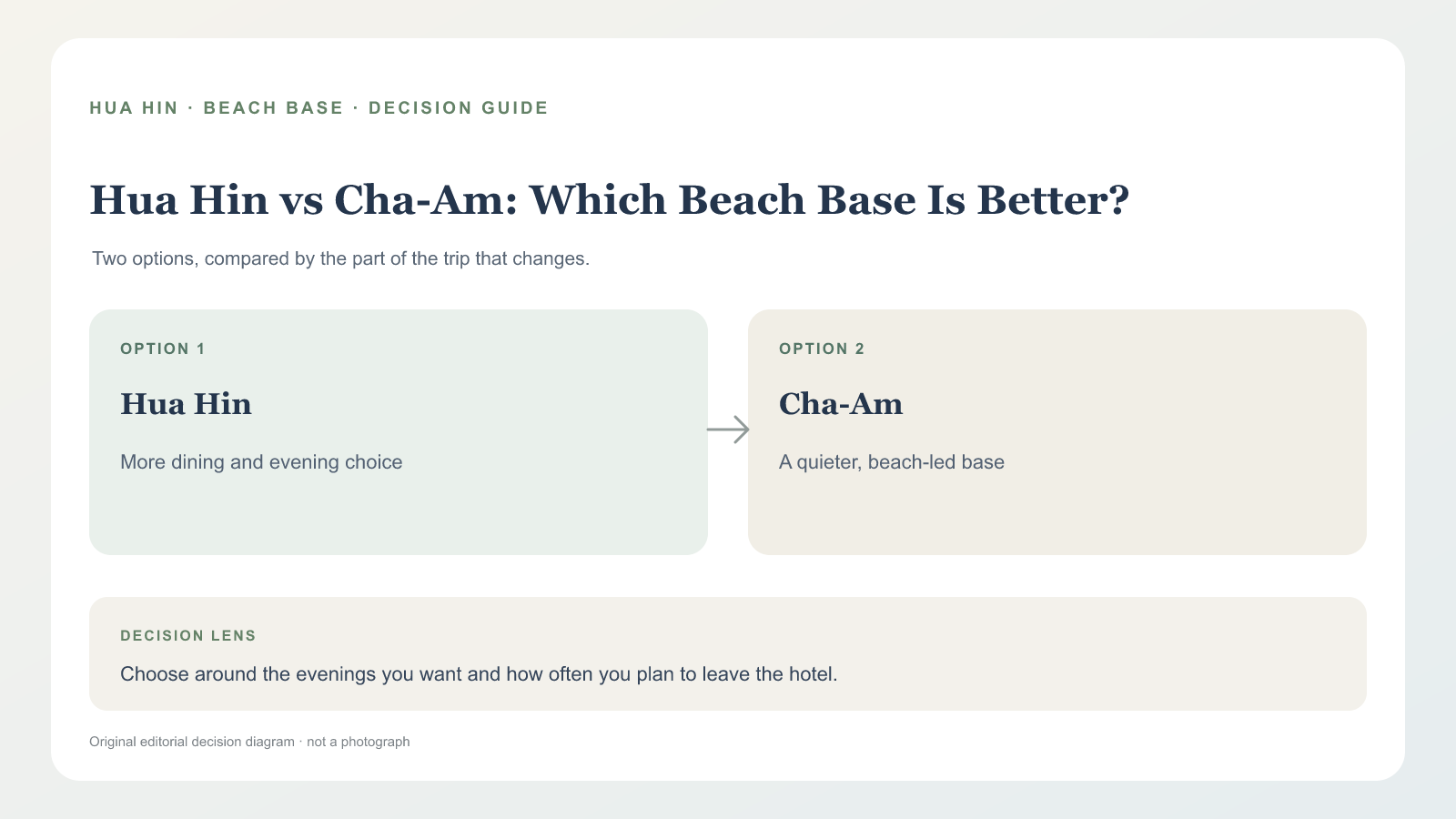
This comparison sits one step above our Hua Hin Centre vs Khao Takiab guide. If you have already decided on Hua Hin, use that page to choose the exact Hua Hin base. Stay here only if you are genuinely deciding between Hua Hin and Cha-Am as the main place to sleep.
Tourism Authority of Thailand currently describes Cha-Am as a quiet beach retreat in Phetchaburi Province, less than 200 km south of Bangkok and about 20 km north of Hua Hin. TAT presents Hua Hin separately as a busier resort destination with beaches, restaurants, a lively night market, inland activities and a broad range of accommodation. They are close enough to combine on a map, but different enough that choosing one and repeatedly commuting to use the other defeats the point of choosing a base.
Use the second-night test
Do not choose from the first afternoon. On arrival day, almost any beach hotel can feel right because you are tired, the sea is in front of you and dinner can be simple. Instead ask: what do you want at 8:30 p.m. on your second night?
If the answer is “I want options and I do not know which one yet,” Hua Hin is the safer base. If the answer is “I want dinner, a walk and an early night because tomorrow is another beach day,” Cha-Am starts to make more sense.
This test works because it measures the part of the stay a hotel photo cannot show: how much outside infrastructure you expect to use once the novelty of arrival has worn off.
Stay planning
Find a place to stay
See available rooms around the property or neighborhood discussed here, with prices for your dates.
Hua Hin buys you an editable evening
Hua Hin's advantage is not simply that it is “more lively.” That description is too vague to help you book. The useful difference is that more of the evening can stay undecided until you are actually hungry, tired or looking at the weather.
TAT currently lists Hua Hin Night Market as one of the destination highlights and describes the city as having seaside restaurants, night markets, beach activities, golf and a wide accommodation range. That matters when your trip is short. A three-night break has only two full evenings after arrival. If one dinner plan changes, one person wants dessert later, or rain wipes out the beach sooner than expected, a base with more fallback options wastes less time.
For two friends, this can be more valuable than a prettier lobby. If one person wants a quiet dinner and the other wants to keep the night going, central Hua Hin gives you more ways to compromise without committing to a long return ride. If that sounds like your trip, the next decision is not another destination comparison; it is Centre vs Khao Takiab and then the breakfast-included vs room-only rate plan.
Cha-Am buys you permission to do less
Cha-Am is stronger when “fewer choices” is a feature rather than a problem. TAT currently calls it a quiet beach retreat and notes that it remains a popular weekend destination, with a long beach, seafood and familiar beach activities. That is a different commercial proposition from Hua Hin: you are not paying for a base to keep producing new things to do after dinner. You are paying for the stay to feel complete without much editing.
This is especially convincing for a two- or three-night reset where you already know the shape of the day: slow breakfast, beach, pool, nap, seafood, sleep. If that is the whole point, booking Hua Hin for “more options” can create options you never use.
The catch is that hotel selection matters more when the outside area is intentionally quieter. A resort that does not suit you cannot be rescued as easily by a long list of nearby alternatives. Check the room, pool, beach access, breakfast plan and evening food options with more care because you are asking the property and its immediate radius to carry a larger share of the trip.
Hua Hin: build a useful radius
Think about the journeys you want to make repeatedly without planning: hotel to dinner, dinner to market, convenience stop to room, or a short evening walk after the beach. The exact hotel entrance still matters, but the destination gives you more ways to make that radius useful.
Cha-Am: build a sufficient radius
You do not need dozens of choices if the ones inside your radius are enough. The question is whether your exact hotel plus the nearby beach and food options can satisfy two or three days without making you wish you had booked farther south.
Run four tickets through both bases
Instead of comparing long attraction lists, give each destination four imaginary “tickets.” If you cannot explain how you will use a ticket, do not count it as an advantage.
Do not solve this by booking “somewhere between”
TAT's current two-day Cha-Am–Hua Hin planner places Maruekhathaiyawan Palace between the two destinations, which is useful for sightseeing. It is not evidence that every hotel along the corridor gives you the best of both towns.
A resort physically between Cha-Am and Hua Hin can be excellent when the resort itself is the destination. It can be awkward when you expect spontaneous nights in Hua Hin and easy beach-town errands in Cha-Am. Halfway is a location, not a compromise automatically.
Before booking a property marketed with both names, open the exact map pin and measure the journeys you will repeat. Do not let “Hua Hin / Cha-Am” in an OTA label replace that check.
Trip length can reverse the answer
| Trip shape | Better starting point | Why | What would change my mind |
|---|---|---|---|
| 2 nights, first visit, no car | Hua Hin | You have little time to recover from a base that feels too quiet after dinner. | A resort you specifically want to stay inside for most of the break. |
| 3 nights, couple or two friends | Hua Hin lean | Two full evenings make optionality valuable without requiring nightlife. | You both want a beach-and-hotel reset and already know you will keep nights simple. |
| 4–5 nights, slow beach trip | Cha-Am becomes stronger | A longer stay gives the quiet rhythm time to become the point rather than a limitation. | You plan several markets, restaurants or outings centred on Hua Hin. |
| 3 nights plus one big national-park day | Hua Hin | The base needs to absorb a long day and still give you an easy evening afterward. | Your Cha-Am resort handles the excursion and you do not need Hua Hin at night. |
| Long weekend where the hotel is the purchase | Choose the hotel first | If pool, spa, room and beachfront time are the product, town comparison matters less. | You realise you will leave the property twice every day; then location becomes the product again. |
Rain exposes the difference faster than sunshine
On a clear morning, both bases can deliver the simple thing you came for: the coast. A wet afternoon asks a harder question: what replaces the beach?
Hua Hin is the easier default if your answer needs to come from the destination—food, shopping, a market when operating, a café, massage or another urban fallback. Cha-Am can still be the better choice if the answer is “the hotel.” A comfortable room, covered spaces, spa time or a resort restaurant can make a rainy afternoon feel intentional rather than wasted.
This is why I would not label one destination universally “better in rainy season.” The booking decision is about where you want the backup plan to live: outside the hotel or inside it.
For a solo woman, audit the final walk rather than the town label
Do not reduce this comparison to “Hua Hin is busier, therefore safer” or “Cha-Am is quieter, therefore calmer.” Neither statement is precise enough to book a hotel. What matters at 9:30 p.m. is the exact final route: lighting, active frontage, road crossing, hotel entrance, whether you are carrying bags, and whether you are comfortable ordering a car if the walk no longer feels appealing.
For two friends, also check whether one person can return to the hotel while the other stays out without creating a complicated pickup. In Hua Hin that often favours a genuinely central pin. In Cha-Am it favours a hotel where the immediate evening radius already contains the dinner and practical stops you expect to use.
Choose Hua Hin if…
You want a first-time base that can handle changing dinner plans, markets, bad-weather edits and different energy levels between two travelers.
Choose Cha-Am if…
You are deliberately buying a quieter coastal rhythm and would be happy if the best hours of the trip happen at the beach or hotel rather than around town.
Do not choose yet if…
Your real priority is one specific resort. Compare the exact property first; a strong hotel can outweigh the town-level default when you plan to spend most of the stay on site.
Six checks before you pay
- Open the exact hotel entrance. Do not use the centre pin for Hua Hin or Cha-Am.
- Trace one real dinner route. Pick somewhere you would genuinely eat at 8 p.m., not the nearest random restaurant on the map.
- Trace the return in rain. A route that looks trivial at noon can feel different with wet sandals, traffic and no covered walkway.
- Find one practical stop. Convenience store, pharmacy or café. This reveals whether ordinary needs require transport.
- Count nights outside the base. If you choose Cha-Am but save three Hua Hin evenings, your shortlist is arguing with your itinerary.
- Check the room plan last. Once the base is right, compare identical room, occupancy and cancellation conditions rather than letting a cheap headline rate choose the town for you.
Only after the base wins, compare actual hotel inventory
The editorial verdict comes first: Hua Hin for the more editable short first trip, Cha-Am for the deliberately quieter beach-and-hotel stay. These are area-level searches, not named-property endorsements, and there is no claim that one OTA will have the lowest rate.
Hua Hin · Compare stays
Check hotels in the Hua Hin base you will actually use
Use the map first, then compare the same room, occupancy and cancellation terms for your real dates.
Cha-Am · Compare stays
Check whether the exact Cha-Am hotel can carry a quiet stay
Prioritise beach access, the immediate dinner radius and the property facilities you will use when you are not going into Hua Hin.
My final rule
If you are still undecided and this is a short first trip, book Hua Hin. Its extra evening flexibility is easier to use than to recreate from a quieter base. Book Cha-Am when the quiet is the reason for going.
The cleanest test is the second night: if you want the destination to keep giving you options after dinner, choose Hua Hin; if you want the hotel and beach to let the day end naturally, choose Cha-Am.
Sources checked
Sources checked 11 August 2026: Tourism Authority of Thailand's current Hua Hin destination page for current destination positioning, night-market and accommodation context; TAT's current Cha-Am destination page for the 20 km relationship, quiet-beach positioning, seafood and weekend-trip context; and TAT's current Cha-Am–Hua Hin two-day planner for the way the tourism authority treats the two as distinct stops that can be combined rather than one interchangeable hotel zone. Hotel rates, transport conditions and business opening hours change; verify your exact booking date and hotel pin before paying.