
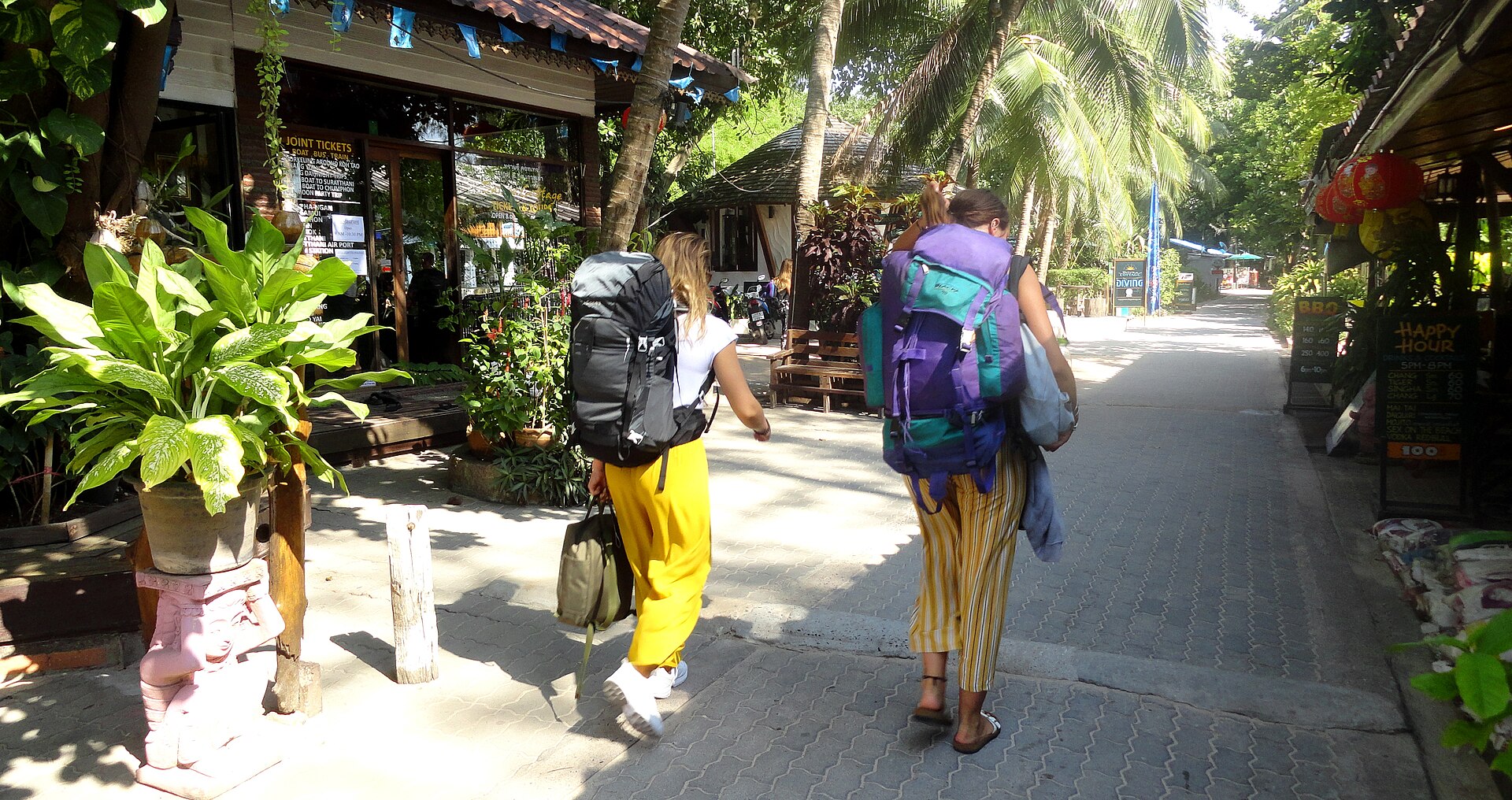
Four friends planning Koh Tao can end up comparing room names long before they have answered the question that drives the trip: are you coming to learn together, or does diving simply sit beside a beach holiday? The distinction changes what “convenient” means. For a first course, the useful radius is the one between your room, the school’s registration point, the training water, meals and the place where everyone can decompress afterward. A lively strip matters too, but it should not decide the hotel before you know how many mornings the group will be at the dive centre.
This is a comparison of two operating styles rather than a claim that one bay has better diving. Ban’s Diving Resort places a large resort and dive operation in central Sairee, with multiple pools, restaurants, bars, rooms and villas. Carabao Diving Resort describes a smaller, concentrated beachfront setup in Chalok Bay, with accommodation, an SSI centre, a pool, restaurant and bar together by the shore. Their official pages describe different layouts; they do not establish equal course prices, class sizes, boat schedules or course outcomes. Get those details from the operator for your dates.
Start with the course calendar, not the room photograph
A beginner course is not a casual snorkel stop. It asks for attention, time in confined water and open-water sessions, and enough energy to listen and practice. Your group may have one person who is confident in the water, another who is nervous, and two who are mainly excited to try. That is a meaningful difference in pace. Ask each school how it places friends who enroll together, whether the course is taught as a private group or in a mixed class, what happens if someone needs more practice, and how the schedule changes if weather or sea conditions disrupt a session.
Do not treat a hotel pool as proof that it is the course pool. Ban’s lists four pools across its resort, while Carabao describes a swimming pool and on-site dive training. Those statements tell you about the property, but not which pool is used for your course, whether access is shared with other guests, or whether your lesson will happen at a separate training facility. Ask the dive centre to identify the exact meeting location and daily sequence. If the answer involves a transfer, count that journey on every course day.
Agree on the course plan before dividing the room cost. A friend who decides against certification after arrival may still join the boat only under a separate activity, may need a different snorkel trip, or may prefer a beach day. Ask whether the operator can coordinate a mixed group without implying that non-divers can join a training boat. Then decide if the remaining three would still be happy with the trip. That conversation avoids booking a high-cost shared villa around a group activity that may not include everyone.
Stay planning
Find a place to stay
See available rooms around the property or neighborhood discussed here, with prices for your dates.
Sairee: more choice around the hours outside class
Ban’s official resort information describes its property as a village-like operation along Sairee, with four pools, restaurants, bars, gardens and a range of accommodation. Its resort page places the property in the center of Sairee Beach. That breadth is useful when four people finish a demanding day at different speeds. One can return to the room, two can eat on site and another can take a dip without the whole group needing to agree on one outing. The trade-off is scale: a large property can mean more internal walking and a busier shared environment, so confirm the room’s actual location relative to the course meeting point and the facilities you care about.
Room configuration deserves a literal check. Ban’s publishes family options, including a Darawan Family Villa with capacity for up to five, and family rooms with two queen beds. That can keep the group under one roof, but sleeping capacity does not answer whether four adults will be comfortable sharing beds. If everyone expects an individual bed, ask for the exact bed configuration in writing or compare two rooms. The property’s category names and its daily diver rates are useful starting points, not a substitute for the specific rate plan, dates, inclusions or cancellation policy.
The attraction of Sairee is strongest when evenings are part of the plan: dinner choices, a sunset drink or simply deciding where to go after the lesson without arranging a ride first. Ban’s identifies its beach restaurant and Fishbowl Beach Bar among its facilities. That is evidence of on-property venues, not a promise of a scheduled party, live performance or particular atmosphere on your travel dates. I would not book on the assumption of an event unless the resort confirms a current schedule. A place to gather is valuable even when nothing is programmed.
For the group that will spend one or two afternoons away from the course, Sairee’s central beach base gives you a wider everyday environment to explore. Still, do not assume that a map pin labeled Sairee means every restaurant or school is a short walk. Check the actual room-to-school route, the slope and whether the hotel shuttle or operator pickup applies to the rate. The related Sairee versus Mae Haad base guide covers the broader island-location question; this page narrows the choice to the routine of a first course with friends.
Sairee Beach · larger resort and evening choice
Compare Sairee stays for the course dates
Match four adults, the exact bed arrangement and cancellation terms. Confirm the room’s route to your named dive centre before deciding that the beach address is close enough.
Chalok Bay: keep the dive day in one compact orbit
Carabao’s official pages describe accommodation, an SSI dive centre, a beachfront pool, restaurant and bar on Chalok Bay, with kayaks also listed among the included facilities. Its accommodation page distinguishes private air-conditioned rooms from dormitory beds. That gives four friends a potentially useful split: book private rooms if sleep and privacy matter, while keeping the communal parts of the day close by. Confirm room availability and bed types directly; the resort’s public page does not promise a four-person suite or four separate beds in one room.
The compact setup has a clear advantage on a course-heavy trip. If lessons, food and a post-dive swim all happen near the same shoreline, the group spends less time coordinating between separate venues. A beachfront pool can offer a low-effort place to sit when someone is tired, and kayaks provide a non-diving water option when available and conditions permit. Those facilities do not mean the group can kayak or swim at any time regardless of weather, sea state or operating rules; check on site and follow staff guidance.
Chalok is the better fit when your ideal evening is a meal and a drink near the bay, then an early night before another training day. Carabao’s page describes sunset volleyball and a beach bar, but it does not publish a recurring public entertainment calendar. Treat the venue as a social meeting point, not as a guaranteed show or nightlife program. If the group wants a succession of bars and a broader choice after dinner, compare the exact route and transport options with Sairee before committing to a quieter bay.
There is also a useful distinction between being on a beach and being able to use it for every planned activity. Chalok’s sheltered, compact feel may suit a relaxed surface interval, but the actual dive site and boat departure can vary by operator and conditions. Carabao says its boat is based at the beachfront. Ask whether your booked course uses that boat for every open-water session and where you board; do not infer the course itinerary from the hotel’s seafront position.
Consider the group’s evening independence. If two friends want to turn in early while two stay for a drink, a compact property with a bar on site reduces the need for everyone to travel together. If the early pair want a separate restaurant or the others want a more active night, the distance to alternatives becomes important. Compare the actual return plan, not just the one-way map. This matters especially if nobody in the group plans to ride a scooter.
Chalok Bay · compact beachfront dive base
Check room choices around your dive schedule
Compare private rooms and nearby alternatives for the same four adults. Verify pier pickup, the course meeting point and the route back after dinner before choosing the bay.
Use a four-person test before choosing either base
Each friend should privately rate three things: comfort in the water, appetite for nightlife and willingness to share sleeping space. Compare answers before you settle the hotel. If confidence levels differ, the school’s teaching setup becomes more important than the resort bar. If nightlife preferences differ, prioritize independent evening options and agree on a meeting point. If bed preferences differ, price two rooms before assuming that a family category is cheaper or more comfortable.
Then make one shared schedule with the operator’s actual start time, course duration, rest requirements, meals and ferry arrival or departure. Leave buffer time around the course instead of filling every afternoon with another excursion. Scuba training already structures much of the day, and adding a long boat trip because it appears on a hotel activity page can turn a relaxed group holiday into a sequence of fixed appointments. For non-diving days, ask what snorkeling or kayaking options are currently operating and whether they are independent rentals, guided trips or part of a specific package.
Four adults also need a clear payment plan. Confirm whether a student rate applies to each enrolled participant and only to nights connected with the course. Ban’s explicitly distinguishes non-diver, fun diver and diving student rates on selected room pages and says course rates apply only to nights when the guest participates. That makes the exact combination important: if one friend takes a course and another does not, do not assume the lower rate applies to the whole room. Ask the property to quote the room and each participant’s activity separately, including breakfast, taxes, deposits and cancellation terms.
At Carabao, its published course-and-stay offer describes accommodation bundled with some course options, including dormitory nights for an Open Water package and paid private-room upgrades. Treat those prices and inclusions as a dated direct offer that can change; check the current package and the private-room total with the resort. A bundle can simplify coordination, but it only saves money if its course, room standard, dates and cancellation conditions match what your group would otherwise buy.
How to make the choice with the least guesswork
Send the same short set of questions to both operators: Can four friends train together? What is the course timetable and expected length? Where does each session meet, and how do guests reach the boat? What happens if one student needs extra practice or cannot continue? Which room category has the bed setup we want? What is included in the quoted total, and what is the cancellation deadline? The replies let you compare the trip you can actually book rather than imagined versions of the two resorts.
For a group that wants a full island stay, social choices after class and several on-site pools, I would shortlist Ban’s in Sairee first, then verify the exact family-room or two-room plan and the walk to the course base. For friends whose priority is to learn together, stay close to the dive operation and keep evenings simple, I would ask Carabao for a private-room package in Chalok and confirm the boat and training routine. If one friend is uncertain about diving, postpone the shared accommodation decision until that person speaks with the school.
Neither choice should be sold as a guaranteed four-person diving bubble. Instructors may place students according to course level, timing and availability; boats carry other guests; beach and pool conditions change. The practical win is to choose a place that still works when the group separates for a few hours. That means sleeping arrangements everyone accepts, enough places to eat nearby or on site, and a straightforward way to regroup without needing every person to follow the same plan.
Once the operator and bay are settled, use the broader Koh Tao area comparison to check whether Sairee or Mae Haad better fits your ferry and evening plans. For a day that does not involve training, compare the current Koh Tao morning versus afternoon fun-dive rhythm with the operator’s actual schedule. If you are coming through Samui, use the Samui Airport to Koh Tao ferry guide to plan the arrival handoff separately from the hotel choice.
Booking decision
Choose Sairee when four friends want their accommodation to support more than the course: multiple pools, on-site venues and a wider evening environment make the larger resort format useful between lessons. Choose Chalok when your group values a compact beachfront dive routine, a pool and a quieter place to regroup. In both cases, reserve only after the dive centre confirms the course format and the property confirms the exact beds, room location and price for the people actually participating.
Sources checked
- Ban’s Diving Resort: resort overview — Sairee location, accommodation scale, pools, bars and restaurants.
- Ban’s: Darawan Family Villa — stated capacity, room details and rate conditions.
- Ban’s: Suite Family — published bedding and rate notes.
- Ban’s: PADI courses — course offerings and operator information.
- Carabao Diving Resort — official resort, course, beach, pool and activity descriptions.
- Carabao: accommodation — private room and dorm descriptions.
- Property details checked October 12, 2026. Availability, rates, course placement, activities and operating conditions can change; confirm directly for your travel dates.