
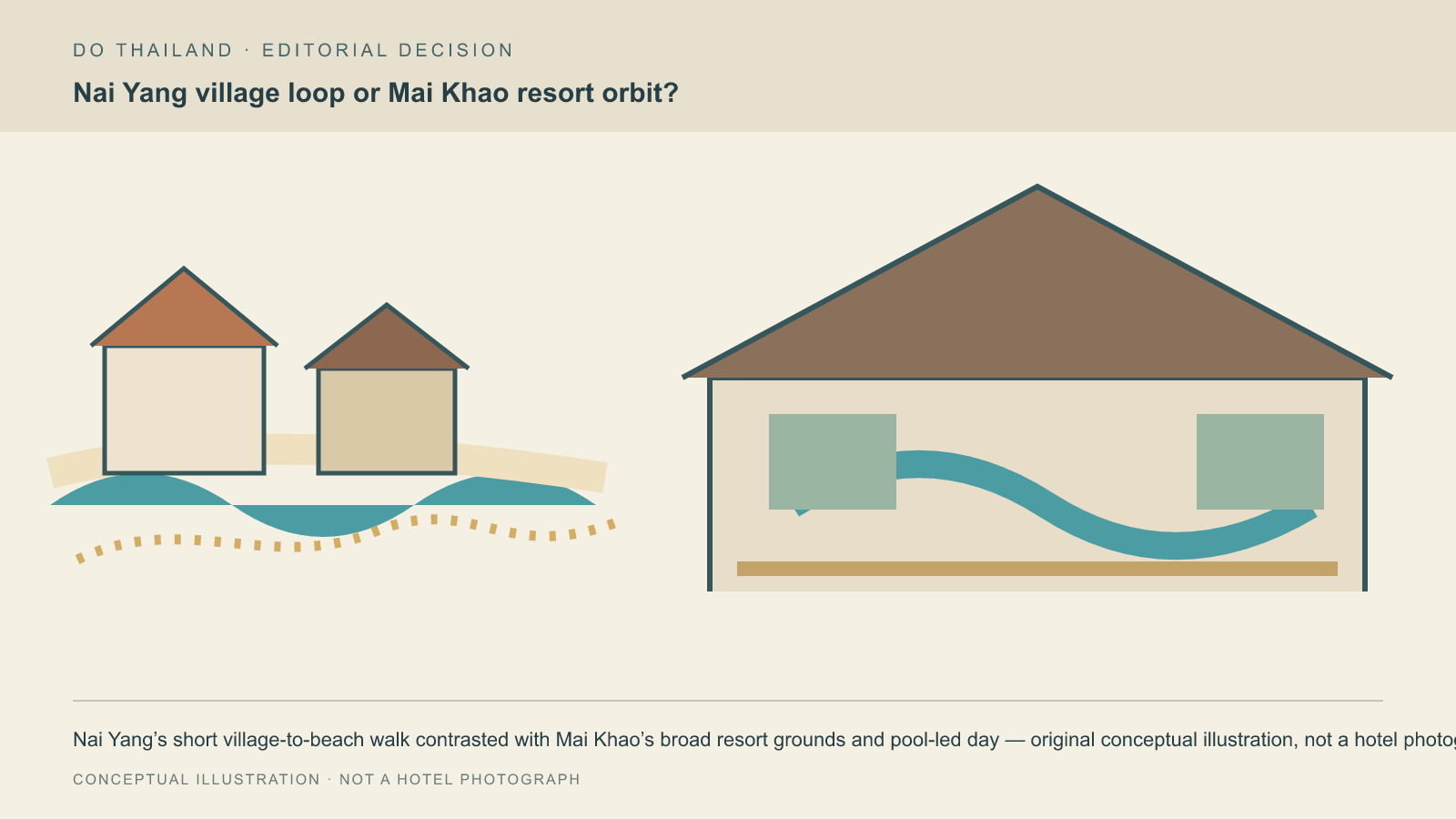
If you are comparing these two because they both sit in Phuket's quieter north-west, resist the urge to choose from beach photos. The more useful question is: how large do you want your everyday holiday radius to be? For a two- or three-night stay, that answer repeats often enough to matter.
Nai Yang
Better when you want a quieter beach base but still value a compact, editable evening around the central beach-road and village side — provided your exact hotel is actually near it.
Stay planning
Find a place to stay
See available rooms around the property or neighborhood discussed here, with prices for your dates.
Mai Khao
Better when a long beach, substantial resort facilities and slower on-property days are the point, and leaving the resort is an occasional choice rather than the default rhythm.
Both look “airport-near” on a Phuket map. The hotel pin tells a different story.
Nai Yang's airport relationship can be genuinely tight. Phuket Marriott Resort and Spa, Nai Yang Beach currently lists Phuket International Airport at 4.6 km from the property. Nai Yang Beach Resort & Spa, closer to the central beach-road area, describes itself as being within a small village community near Sirinat National Park and only a short drive from the airport.
Mai Khao is still north Phuket, but its resort belt stretches farther. JW Marriott Phuket Resort & Spa currently lists HKT at 15 km from the property. That is still convenient compared with crossing the island to the busier south-west beaches, but it is not interchangeable with a hotel sitting almost beside the airport.
This distinction matters most when you are carrying luggage, landing after dark or leaving on an early flight. For a pure first-or-last-night problem, use our narrower Nai Yang vs Bang Tao flight-night guide. This article is for the harder case: you actually have two or three nights and want the north-coast base itself to feel right.
Run the three-radius test
Mai Khao works when “staying in” is not a compromise
Mai Khao should not be treated as a failed version of Patong, Kata or Bang Tao. Its strongest hotels are designed for a different holiday. JW Marriott's current property information describes a large beachfront resort with multiple restaurants, pools, spa facilities and on-property activities. Around the northern Mai Khao resort cluster, Turtle Village currently lists restaurants, cafés and shops and publishes daily opening hours from 10:00 to 22:00.
That outside cluster is important because it stops “resort-led” from meaning “trapped.” But it still does not turn Mai Khao into a continuous walk-out beach town. Your exact property location matters. A resort close to Turtle Village behaves differently from one farther down the beach.
Mai Khao becomes persuasive when you can say yes to at least two of these: you want a proper resort day; you are likely to book spa or long pool time; you are happy eating several meals on or immediately around the property; you prefer quiet evenings; or you are using the hotel as recovery time after a busier Bangkok, Chiang Mai or island-hopping section.
If instead you expect to leave almost every day for the west-coast restaurant scene, compare the trade-off with Bang Tao vs Kamala. If Bang Tao is already attractive but you are torn between sand and dining convenience, Bang Tao Beach vs Boat Avenue is the more useful next decision.
Nai Yang is the quieter base for travelers who still like to improvise
Nai Yang's advantage is not nightlife. It is optionality at a smaller scale. The provincial government describes Nai Yang as very close to the airport and part of the Sirinat National Park beach system. A central Nai Yang hotel can give you beach access, a low-key evening and a shorter airport handoff without requiring the resort to entertain you for the entire stay.
But there is a trap here: a hotel named “Nai Yang” may sit outside the central village strip; check its exact pin and walking route. Phuket Marriott Resort and Spa, Nai Yang Beach, for example, is a quiet beachfront resort in the area rather than proof that every Nai Yang stay behaves like a village hotel. Check the entrance pin because the beach name covers a wider area.
The exact-pin rule
Open the map at 20:30, not 11:00. Look at the hotel entrance, the road you would use after dinner, and what is actually within a comfortable walk. A five-minute daytime map line can feel very different after rain, with wet sandals, a tote bag and a road edge you did not notice while choosing the room.
If you already know you will use rides for most evenings, compare that assumption with our Phuket scooter vs Grab guide rather than mentally pricing every hotel as if the island were walkable.
A three-night stay exposes the difference faster than a one-night stay
Nai Yang is forgiving if you want to drop the bag and make one small decision at a time. Mai Khao feels better if your ideal first move is pool, shower, resort dinner and an early night.
Mai Khao earns its space when you actually use the resort. Nai Yang earns its flexibility when your day changes and you still want a simple independent evening afterward.
Both keep you in north Phuket, but the exact transfer remains different. Airport proximity is a property-level fact, not a beach-label guarantee.
This is why a two-night Mai Khao booking can feel excellent for someone who wants to stop moving and strangely restrictive for someone who keeps opening Maps to see what else is nearby. Neither reaction means the area is objectively better or worse; it means the traveler bought the wrong radius.
Do not choose either beach assuming calm-looking water means safe swimming
North Phuket's quieter setting can make the beaches look deceptively simple in hotel photography. The Phuket Provincial Government's Mai Khao page specifically warns that the beach is not suitable for swimming during the monsoon season because of strong currents and the steep beach profile. Tourism Authority of Thailand also tells visitors to pay attention to red flags on Phuket beaches.
That means the “better beach” question should never override conditions on the day. If a red flag is up, treat it as the answer. A hotel with a good pool becomes more valuable in rough-weather periods, and a stay with dining and spa fallback becomes easier to enjoy when the sea is not cooperating.
If your shortlist is moving south because you want a broader beach-town setup, our Kamala vs Surin comparison and Kata vs Karon guide solve different versions of that problem.
The 21:30 test for solo travelers
For a woman traveling alone, the more useful comparison often starts after dinner rather than at the pool. Before booking, answer four questions from the exact hotel pin:
- If you decide not to eat at the hotel, can you reach the alternative without walking a dark or uncomfortable road edge?
- If rain starts while you are out, is a ride pickup straightforward at the entrance you will actually use?
- Will you be returning to a staffed resort lobby, a small hotel entrance, or a more isolated driveway?
- Would you still be happy with the location if you decided not to rent a scooter?
A central Nai Yang pin usually has the better chance of passing the “small independent evening” test. A Mai Khao resort can pass it differently: by making the hotel itself somewhere you are content to stay after dark. Those are two legitimate forms of convenience.
Three traveler profiles make the decision much easier
For travelers whose real priority is an integrated resort network with more internal movement and dining infrastructure, Laguna Phuket vs Cherng Talay is another useful benchmark. It shows what a larger resort ecosystem looks like when restaurants and internal transport are deliberately built into the destination.
Stay planning · Compare the right north-Phuket radius
Shortlist the location first, then the room
Use Nai Yang if you want the quieter airport-side beach with more potential for a self-directed evening; use Mai Khao if you want the resort to carry more of the holiday. Check the exact hotel entrance, cancellation terms and room for your dates before committing — especially if walking out after dinner is important to you.
Before you book, check these five things on the actual property page
- Airport transfer: do not assume a hotel provides a free shuttle because it is near HKT. Current Marriott pages for both the Nai Yang and JW Mai Khao examples state that the hotels do not provide a standard airport shuttle.
- Hotel entrance: check where the car actually drops you, not the midpoint of the beach label.
- Dinner fallback: identify at least one option you would genuinely use if you were tired, wet or did not want to arrange a ride.
- Pool and indoor fallback: these matter more when sea conditions are poor.
- Your first long transfer: if the next day begins with a long trip south, count that journey before calling the north-coast hotel “convenient.” For comparison, see Phuket Airport to Patong and Phuket Airport to Bang Tao.
The deciding question
When you picture 8 p.m. on your second night, do you want to choose what happens next from outside the hotel — or are you hoping the hotel is where the evening happens?
If you want the choice to stay open, start with a central Nai Yang pin. If you want the resort to become the destination, Mai Khao is easier to love. Then compare properties inside the winning area rather than trying to make a great hotel fix the wrong holiday geometry.
Continue with the Phuket destination hub or browse all Thailand stay guides.