
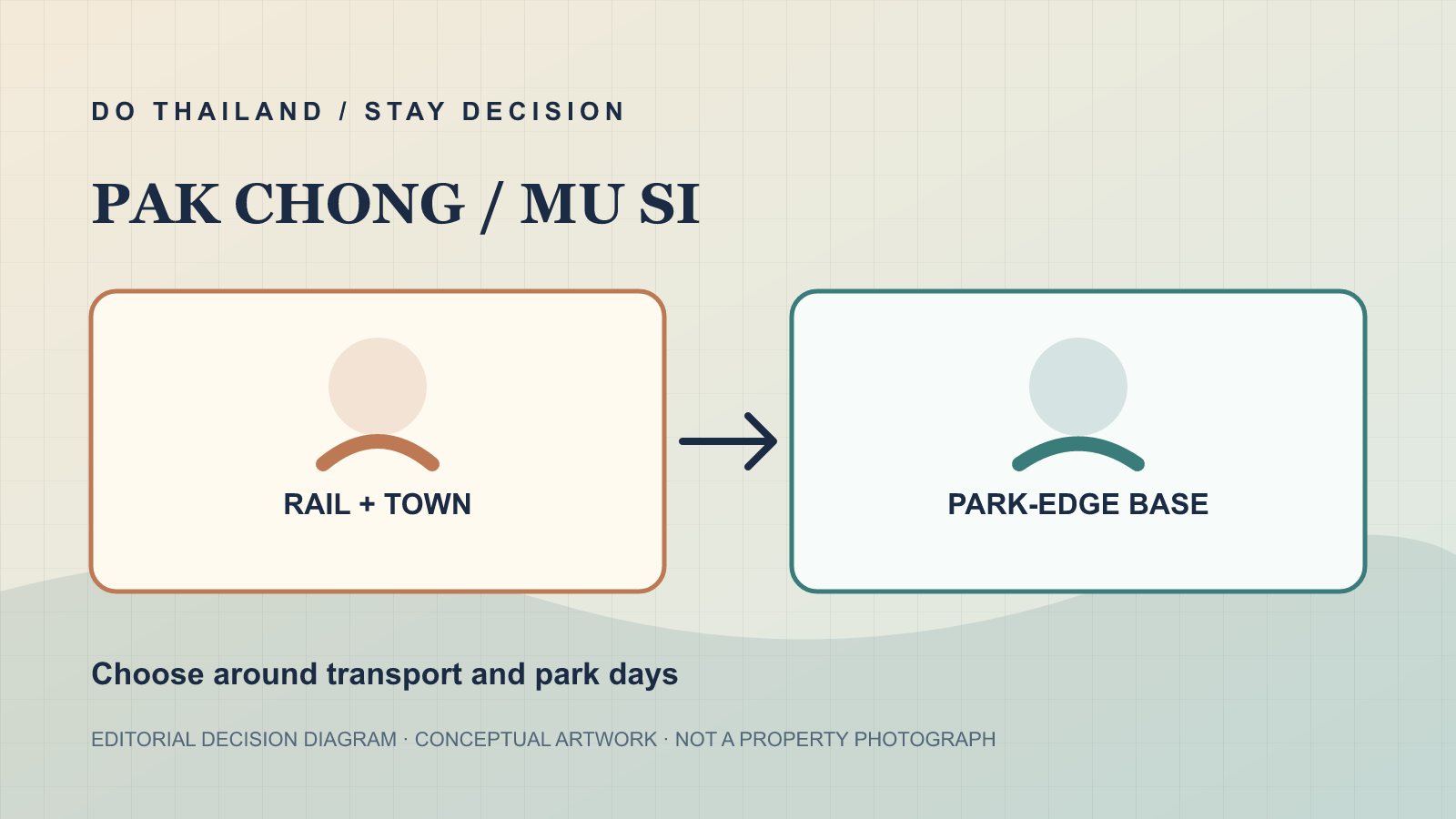
If Khao Yai is being added after Bangkok, settle the Bangkok end first. Where to Stay in Bangkok helps when the city base is still undecided, while our red-eye arrival guide is the better upstream decision if you are tempted to stack a long road or rail transfer onto an exhausted first day.
First, fix the geography: Mu Si is inside Pak Chong District
This comparison uses “Pak Chong” as shorthand for Pak Chong town around the railway station and market, and “Mu Si” for the park-facing tourism area along the northern Khao Yai approach. Mu Si is administratively a subdistrict of Pak Chong District, so an OTA can label both hotels “Pak Chong” even when they create very different daily logistics.
That label problem matters. The Khao Yai National Park contact information places the park address in Mu Si, Pak Chong, and the official park site identifies the northern Chao Por Khao Yai entrance as the Pak Chong entrance. Tourism Authority of Thailand also places multiple Khao Yai attractions and hotel/café examples in Mu Si. So do not choose by the broad district name. Open the exact pin and ask which side of your trip it serves.
Stay planning
Find a place to stay
See available rooms around the property or neighborhood discussed here, with prices for your dates.
Two versions of a Khao Yai stay
Pak Chong town: make the handoff easy
Pak Chong town earns its place when the railway station, bus/minivan arrival, food errands or a late arrival are the hardest parts of the trip. State Railway of Thailand currently lists Pak Chong on the northeastern line, and its current timetable matrix continues to publish services calling there.
The benefit is not that Pak Chong town is “closer to everything.” It is that one fixed transport anchor becomes easy. For a one-night stop, a solo traveler with luggage, or anyone arriving after dark, that can be more valuable than waking up farther along the park road.
Mu Si: make the park-facing day easier
Mu Si earns its premium when Khao Yai National Park, the northern entrance and the park-road side of the trip are repeated anchors. The official park address itself is in Mu Si, and the northern entrance is the side reached from Pak Chong District.
But Mu Si is not a magic “no transport needed” zone. Hotels, cafés and attractions are spread along roads rather than one compact pedestrian centre. A beautiful pin can still create ride dependence. Mu Si works best when the exact hotel and your vehicle plan already make sense together.
Budget for transport as well as accommodation
The no-car trap: Pak Chong is the gateway, not the solution
The official Khao Yai National Park travel page is unusually clear: private car is described as the most convenient option because there is no transportation service inside the park. It currently describes bus/minivan or train travel to Pak Chong, followed by local transport toward the Chao Por Khao Yai entrance, but onward movement between park attractions still needs to be solved separately.
That means a train ticket to Pak Chong is not, by itself, a complete independent Khao Yai transport plan. If you are not driving, decide who moves you after the gate before deciding whether a Mu Si hotel is “closer.” A pre-arranged driver, a hotel transfer with confirmed scope, or a guided day can turn Mu Si into the easier base. Without that second layer, moving farther from the station can simply relocate the transport problem.
If rail is part of your plan, use our Bangkok hotel to Krung Thep Aphiwat guide for the city-side station handoff, then recheck your actual Pak Chong service on SRT for the travel date. Do not copy a timetable from an old blog into a fixed itinerary.
Work backward from the park gate, not forward from hotel check-in
Khao Yai National Park currently publishes daily opening hours of 06:00–18:00. If your ideal day begins near opening, ask what has to happen before 06:00: breakfast, pickup, loading water, meeting a driver and reaching the entrance. Then count those steps backward from the gate.
Mu Si wins when that reverse clock is the repeated stress you want to remove. A park-heavy two- or three-night trip can justify waking on the northern-entrance side because you use that advantage more than once.
Pak Chong wins when the reverse clock happens only once but the station handoff happens twice. If you arrive by train, sleep, take one organized park day with pickup, then leave by train again, the town can be the more rational base even though it sits farther from the gate.
Arrival night and final morning can overturn the “closer to nature” instinct
Late arrivals make base choice less romantic. If a train or bus reaches Pak Chong after you would realistically want to start navigating unfamiliar roads, I would rather shorten the first handoff and protect sleep than move immediately to a scenic hotel just to wake slightly farther along the route.
The same logic applies on departure. If your final morning is tied to a train, do not make a Mu Si resort breakfast, checkout, luggage load and road transfer all sit in front of one fixed departure unless the hotel transfer is confirmed. A short trip has very little slack for one weak handoff.
If your wider trip still includes an airport choice before Bangkok, solve BKK vs DMK first. A Khao Yai base cannot compensate for a poorly sequenced airport, city and intercity chain.
Mu Si is stronger when the hotel is allowed to carry part of the trip
A Mu Si stay becomes more convincing when you are not trying to leave the property for every meal, coffee and evening. TAT's Khao Yai material places hotels, cafés and attractions across Mu Si, which supports the area as a real tourism corridor—but it does not mean every hotel is walkable to every useful place.
This is where exact-pin thinking matters. If your chosen property has the restaurant, pool, garden or slow evening you actually want, then the more dispersed setting can be a feature. If you expect to improvise dinner, walk between venues and change plans late, verify the final road rather than assuming “Mu Si” functions like a compact resort town.
For women traveling solo, my practical threshold is simple: do not let a pretty aerial map become the evening plan. Check whether you can return independently after dinner, whether ride pickup is straightforward at the property entrance and whether you would still be comfortable with that plan in rain. For two friends, ask the same question twice: can one person leave early without taking the other's transport with her?
Two nights and three nights create different winners
Two nights: protect the dominant anchor
Choose Pak Chong town when one organized park day sits between a rail/bus arrival and rail/bus departure. You are buying a low-friction shell around a fixed excursion.
Choose Mu Si when both usable mornings are park-facing or resort-facing and the car/driver is already solved. Then the first and last useful hours both point away from the station.
Three nights: Mu Si gets more room to earn itself
With three nights, a Mu Si base can absorb a full park day, a slower property morning and another Khao Yai-area block without every hour being a transfer calculation. The location premium has more chances to remove road time.
Pak Chong still wins for a train-led trip if you prefer to treat Khao Yai as one or two pre-arranged excursions and keep the rest of the stay operationally simple.
Do not split Pak Chong and Mu Si automatically
A two-night trip almost never needs one night in each just to “experience both.” You pay with two checkouts, two bag packs and an extra transfer to solve a distance that should first be handled by choosing the right base.
A split starts to make sense only when the trip itself changes job: for example, a late rail arrival where sleeping in town genuinely protects the night, followed by several resort-heavy nights in Mu Si. That is not destination collecting. It is using each hotel for a different operational purpose.
Six questions that decide the base faster than a hotel list
- How are you arriving? Train/bus into town gives Pak Chong a real first-night advantage; direct car from Bangkok reduces it.
- Who moves you inside Khao Yai National Park? If the answer is unclear, solve that before paying for a park-side hotel.
- How many mornings point toward the northern entrance? Repetition is what makes Mu Si valuable.
- How many evenings do you expect the hotel to carry? The more you stay in, the more a deliberately chosen Mu Si property can earn its setting.
- Is there a fixed train or bus on the final day? Fixed departures make town-side simplicity more valuable.
- Would you still like the exact hotel pin in rain and after dark? Check pickup, lighting and road access; do not outsource that decision to the district label.
After the base wins, compare stays around the right anchor
The editorial verdict comes first: Pak Chong town for transport-first handoffs; Mu Si for repeated park-facing or property-facing time once mobility is solved. Use the area links below to compare current availability, total price and cancellation terms for the same dates.
Pak Chong town · Compare stays
Shortlist around the arrival and departure anchor
Compare the exact entrance, station handoff, luggage route and cancellation terms for your dates instead of choosing by a broad Pak Chong label.
Mu Si · Compare stays
Shortlist on the park-facing side
Check the exact hotel pin, confirmed park transfer, dining plan and the road you will use after dark before paying for a more resort-led base.
My final rule
Stay near the anchor you control least. If a fixed train, bus and luggage handoff control the trip, Pak Chong town usually wins. If transport is already solved and the park entrance, park mornings or resort time are what you will repeat, Mu Si earns the move. A Khao Yai hotel is not “better located” because it looks greener on the map; it is better located when it removes the movement your actual itinerary would otherwise repeat.
Sources checked
Sources checked 12 August 2026: Khao Yai National Park's current Getting Here, Contact and Plan Your Visit pages for the Pak Chong entrance, Mu Si address, 06:00–18:00 opening hours and the current statement that there is no transport service inside the park; the park's current Thai travel/closure page for the 2026 Pha Diao Dai seasonal closure notice; State Railway of Thailand's current 2026 northeastern timetable matrix and station contact listing for Pak Chong station; and Tourism Authority of Thailand's current Nakhon Ratchasima destination page plus its Khao Yai/Mu Si material for regional context. Transport schedules, park closures and hotel pickup arrangements can change; recheck the exact travel date before paying.