
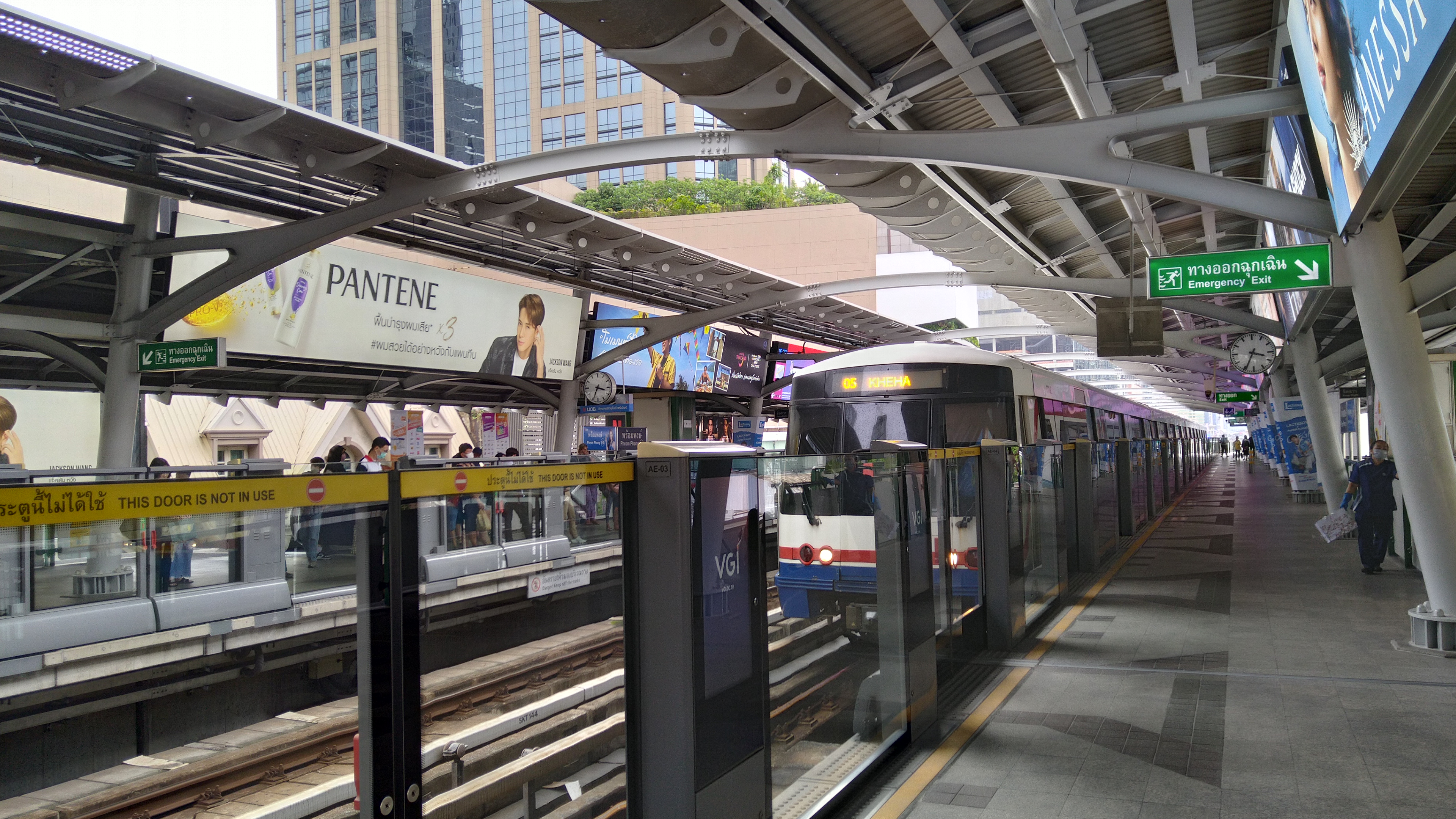
My default for a short visit: use a contactless EMV bank card on MRT if your card is eligible, buy single-journey tickets for occasional BTS rides, and get an adult Rabbit card only when you expect to use BTS repeatedly. Carry a backup payment method and keep the same card or device for entry and exit on each MRT trip.
The key limit: MRT’s June 2026 EMV upgrade covers the four MRT lines under MRTA, while BTS Skytrain still publishes Rabbit and single-journey options. Do not assume a Visa or Mastercard tap that worked at an MRT gate will open a BTS gate.
What changed in 2026, and what did not
On June 1, 2026, Bangkok’s Mass Rapid Transit Authority and operator BEM moved MRT fare collection to EMV contactless payment. MRTA says eligible cards can be used across its four lines: Blue, Purple, Yellow and Pink. BEM’s current transition notice lists contactless Visa and Mastercard credit cards from any bank, and selected debit, UnionPay and prepaid products. If you use an overseas card, check that it has the contactless symbol and that your issuer allows overseas transactions; BEM’s current notice says internationally issued contactless cards are supported under its accepted networks and conditions.
This is a meaningful improvement for visitors who expect to ride the MRT. It is not an all-Bangkok common ticket. The BTS Skytrain has its own fare gates and ticket products. BTS currently lists adult Rabbit cards, single-journey tickets and a One-Day Pass; it also says single-journey tickets can be bought at machines using coins or QR payment. MRTA’s contactless announcement does not say that those cards work on BTS.
The practical map matters more than the logo on the card. BTS is especially useful for the Sukhumvit and Silom corridors, Siam and connections to shopping districts. The MRT Blue Line serves places such as Sukhumvit, Sanam Chai, Hua Lamphong and Chinatown’s Wat Mangkon station. Your hotel and planned stops determine which payment setup is worth arranging.
Choose by the lines in your actual itinerary
| Your likely travel pattern | Simple choice | Why |
|---|---|---|
| One or two MRT rides, mainly Blue Line | Eligible EMV contactless bank card | Skip buying stored value just for those trips; tap the same card or device to enter and exit. |
| Several MRT rides across Blue, Purple, Yellow or Pink | One eligible EMV card per rider | MRTA says the four lines it oversees accept EMV contactless. Separate fares still apply according to the journey and current rules. |
| Several BTS rides over a few days | Consider adult Rabbit | It avoids selecting and buying each BTS single ticket. Compare its issuance cost and the balance you may leave unused against the number of rides you expect. |
| Only one BTS ride, or your day is mostly walking and boats | BTS single-journey ticket | You avoid buying a separate card for a small number of trips. Check machine payment options at the station you use. |
| You will mix BTS, MRT, boats and taxis | Use line-specific payment | No single payment choice described here covers every mode. Keep a bank card for eligible MRT gates, Rabbit or single tickets for BTS, and separate payment for other operators. |
Rabbit is a convenience purchase, not an automatic money-saver
An adult Rabbit card can be purchased at BTS ticket offices. BTS’s current issue instructions list a 120-baht card issuance fee, say there is no card deposit, and require at least 100 baht of stored value when adding value. The value is deducted according to the published fare table. Treat the issuance fee as the price of reducing ticket-machine friction, not as a refundable deposit or a fare discount.
For a three-day city break with perhaps two BTS rides on each busy day, Rabbit may be worth the small setup because it reduces time spent choosing a destination at the machine. If your hotel is beside an MRT station and your plans cluster around Old Town, Chinatown and Sanam Chai, a new Rabbit card may sit mostly unused. Run the choice against your map before you buy it.
Do not load a large balance simply because a top-up screen offers it. The card can be convenient later, but a short visitor may not return to Bangkok or may finish the trip with value remaining. Load for the rides you can reasonably predict, then top up if the itinerary changes. Adult Rabbit is the relevant fare-card category for most adult tourists; BTS’s student and senior cards have eligibility conditions that make them poor assumptions for ordinary visitors.
Bangkok stay planning · BTS access
Base near the BTS shopping corridor
Siam and Chit Lom suit days built around central shopping. Check the walk to the station and whether your other plans depend more on MRT.
Contactless MRT works best when you keep one credential per person
At an MRT gate, use the same physical card or the same device wallet for both entry and exit. If you enter with your phone and tap out with the plastic card linked to it, the system can treat those as different credentials and fail to match the journey. Each traveler needs their own payment credential: one card cannot normally be tapped in for a group and passed back for the next person to exit.
For a couple or family, decide before the first gate who is using which card. A parent can use a phone while another adult uses a physical card, as long as each person keeps their own credential. A child without an eligible bank card can use the operator’s available ticket option at the station; confirm age-related fares and ticket procedures with the operator rather than assuming a child can travel on an adult’s tap.
A contactless bank card is also not the same as a Bangkok-wide stored-value wallet. MRTA’s EMV announcement explains travel on MRT lines, not automatic transfer discounts across BTS, river boats or buses. Budget separate fares and allow for the physical interchange walk when changing operators.
When a single ticket is the calmer choice
Single tickets work well when the route is still uncertain, you are taking only a few train rides, or your card issuer blocks an unfamiliar transit transaction. BTS explains that its ticket machines sell a single-journey card for a selected destination and support coin or QR payment; the BTS site also notes banknotes at some top-up machines, so check the exact machine instructions rather than expecting every machine to accept cash bills.
At busy stations, buying at a machine adds a small queue and a destination-selection step. That cost matters during the evening rush or when your group is trying to catch a timed appointment. If you will ride BTS every day, Rabbit may be easier. If you only need one trip from Siam to a nearby stop, the single ticket is perfectly adequate.
There is no need to buy both a Rabbit card and an MRT pass before you know your plans. Start with the hotel pin and the day’s endpoint. Our Bangkok hotel-area guide compares the broad trade-offs between Sukhumvit, Siam and Riverside, while near-BTS hotels and deep-soi stays explains why a station’s advertised proximity can still involve a long last walk.
Do not buy a BTS One-Day Pass just because you have a busy day
BTS says a One-Day Pass is available at ticket offices, but the decision depends on the pass’s current price and the fares of the journeys you will actually take. Count your planned BTS rides, not every movement around Bangkok. A day with two BTS rides, three MRT rides and a river ferry is not five BTS journeys. Check the current official pass terms and fare table at the time of travel; older blog posts may show a price or validity rule that has since changed.
A pass can make sense if you expect enough BTS trips to exceed its price and want to avoid separate ticket purchases. It makes less sense for a river-and-Old-Town day, where the MRT or boat may do most of the work. For a structured heritage route, our Grand Palace, Wat Pho and Wat Arun sequence helps you decide where rail ends and the river crossing begins.
My practical setup for three common Bangkok trips
First visit, hotel near Asok, four days
I would bring one contactless card for MRT and use single BTS tickets at first. Asok is an interchange between BTS and MRT, so the days may use both operators, but there is no need to purchase a Rabbit before seeing the pattern. If your first two days involve repeated BTS rides, buy Rabbit then; if most heritage stops use the Blue Line, keep using the bank card for those MRT journeys.
Shopping-heavy days around Siam and Chit Lom
Expect BTS to do more of the work. Rabbit can reduce repeated ticket-machine stops, especially when several adults are making multiple trips. It will not replace each traveler’s payment credential on MRT, so keep the systems separate when you cross to an MRT destination.
Two nights, mostly Old Town and Chinatown
Keep it light: use an eligible contactless card for MRT and buy an occasional BTS single ticket only if your route calls for one. Sanam Chai and Wat Mangkon are MRT stations, while riverside ferries and local walks cover other parts of the heritage day. A transit card purchase should solve repeated friction you will actually encounter; it should not become another airport errand.
Bangkok stay planning · BTS and MRT interchange
Compare an interchange base near Asok
Asok connects BTS and MRT, which can help when your plans use both systems. Check the exact station entrance and hotel walking route.
Before your first tap
- Confirm your bank card is EMV contactless and ask your issuer whether overseas transit purchases are enabled.
- For MRT, use the same card or device to enter and exit; do not share one credential across riders.
- For BTS, choose Rabbit for repeated use or buy single-journey tickets when trips are sparse.
- Keep a backup card or cash for ticket machines, a declined transaction or a line outside the EMV network.
- Check the current fare and One-Day Pass terms on the relevant operator’s site. Fare promotions and operating details can change.
If a train does not serve the exact hotel entrance or evening destination, compare the door-to-door options before adding another interchange. For onward rail travel, see MRT or Grab to Krung Thep Aphiwat. For a larger trip beyond Bangkok, the Bangkok destination hub links the current stay, transport and experience decisions.
Plan from the station you will actually use
Map the day’s first and last stops, then pick ticket products for those operators. Start with the transport guide index if your next decision is the airport transfer or a trip out of Bangkok.
Sources checked · October 12, 2026
MRTA, EMV Contactless MRT announcement, published February 27, 2026, covering the June 1, 2026 implementation and its four supervised lines; BEM, MRT legacy-card transition notice and EMV Contactless instructions, checked October 12, 2026, for accepted networks and tap-in/tap-out guidance; BTS SkyTrain, how to purchase a Rabbit card, including issuance fee and stored-value rules; BTS SkyTrain, single-journey ticket machines and One-Day Pass sales; BTS SkyTrain, Rabbit eligibility conditions; BTS SkyTrain, single-journey ticket information. No photo is used because an illustrative transit image would add decoration without helping identify a station or explain the payment decision.