
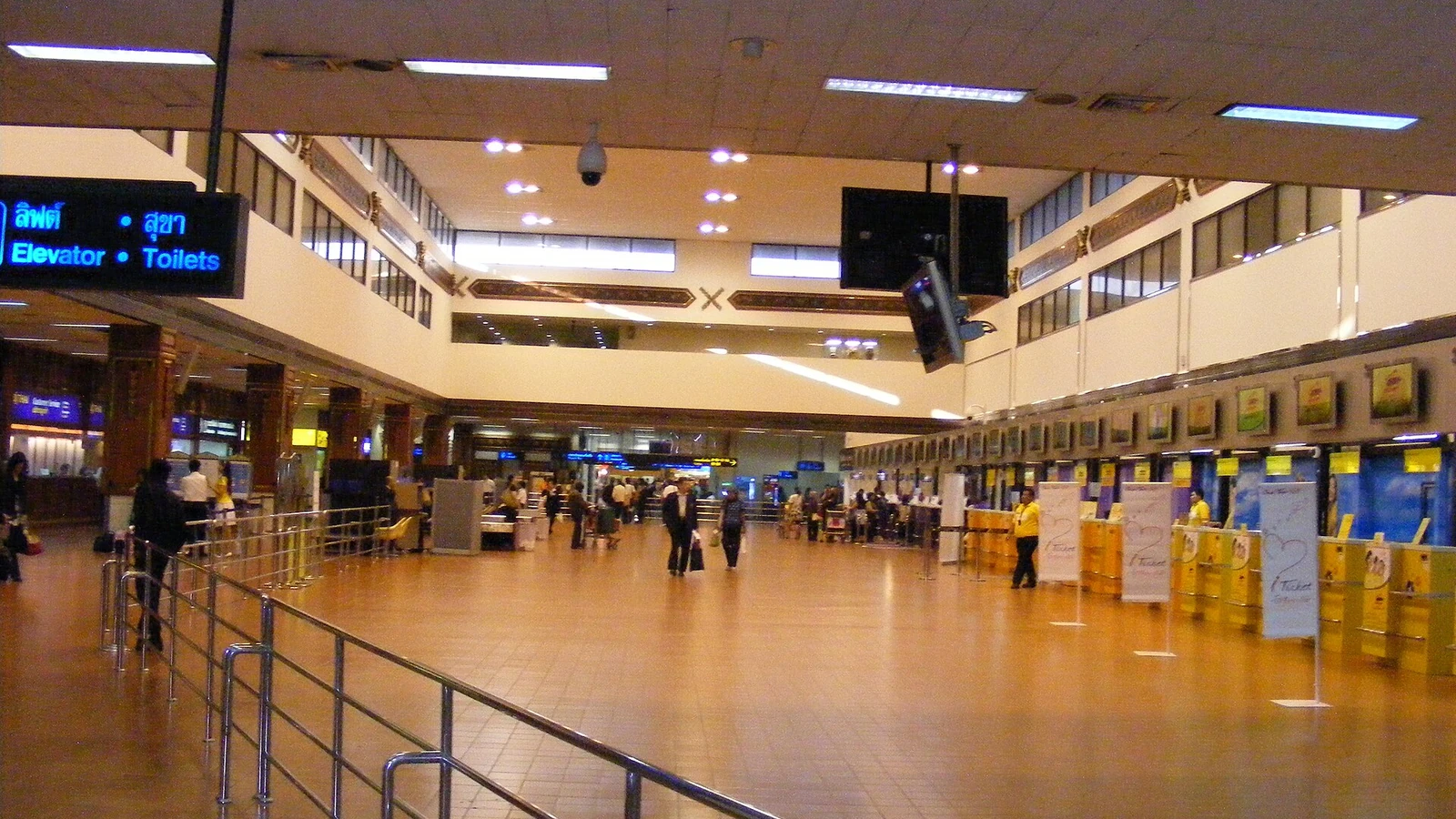
For a DMK arrival heading to Sukhumvit, I would compare rail with a direct car using your hotel pin, luggage and the time you expect to leave the arrival hall. The rail route is Red Line to Krung Thep Aphiwat, a station-complex transfer to MRT Blue Line at Bang Sue, then on to Sukhumvit (BL22). It works best when the hotel is near Asok and the final walk is short.
If you are still choosing which Bangkok airport to use, start with BKK vs DMK. This page assumes the flight is already arriving at Don Mueang and you are heading to Sukhumvit.
The useful rail chain is DMK → Krung Thep Aphiwat → Bang Sue MRT → Sukhumvit
The Red Line station is linked to Don Mueang Airport. Ride south to Krung Thep Aphiwat, then follow station signs to MRT Bang Sue for the Blue Line. An adult Red Line ticket from Don Mueang to Krung Thep Aphiwat costs THB 33.
At Bang Sue (BL11), Exit 3 leads toward the main rail terminal; elevators are available at Exits 1 and 3, with escalators at all station entrances and exits. At Sukhumvit (BL22), Exit 3 connects to Asok BTS. That last transfer is useful for hotels farther along the BTS line, but it adds another station change.
For a hotel beside Asok, this is usually the simplest rail version: one interchange between lines, then a short walk if the hotel pin is close. If you are still choosing a base, compare where to stay in Bangkok and Asok vs Phrom Phong; Sukhumvit does not have one uniform airport connection.
Sukhumvit is where the rail answer splits into three different trips
Asok / Terminal 21
Red Line to Krung Thep Aphiwat, one station-complex handoff to Blue Line, then MRT straight to Sukhumvit. If reception is close to the exit, the chain is coherent.
Nana / Phrom Phong
You can continue by transferring from MRT Sukhumvit to BTS Asok. With a small bag, that may still be fine. With a large case, it becomes another platform, gate and lift/escalator problem.
Thong Lo or deep sois
The farther you ride east on BTS—or the farther reception sits from the station—the less important the Red Line's low fare becomes. The final kilometre can decide the whole trip.
For hotels advertised as “near BTS,” check the exact pin rather than the marketing phrase. Our near BTS vs deep-soi hotel guide explains why a property can be in an excellent district yet still be annoying with luggage. If you are choosing farther east, Phrom Phong vs Thong Lo gives the more useful micro-location trade-off.
Red Line fare covers one leg, not the hotel trip
The THB 33 fare covers only the Red Line ride to Krung Thep Aphiwat; add the MRT fare and any later BTS or car ride. The Red Line runs daily from 05:30 to midnight, while the Blue Line runs from 06:00 to midnight. I would not plan a tight connection near closing time: you still need to reach the Red Line, make the station transfer and board the last Blue Line train.
None of those facts means your airport-to-hotel journey is “33 baht” or that a flight landing near the final train gives you a safe rail connection. You still have to clear the aircraft, collect bags, reach the station, wait, transfer between rail systems and get from the last station to reception.
| Arrival setup | Better default | What changes the answer |
|---|---|---|
| Domestic arrival, one cabin-size bag, hotel beside Asok/Sukhumvit | Red Line + MRT | The train chain ends close to the hotel, so the transfer buys traffic independence without creating a difficult last mile. |
| International arrival, checked luggage, Asok hotel | Still possible by rail | Use actual arrival-hall time, not touchdown. Immigration and baggage can consume the margin you thought you had. |
| Two travelers with large suitcases, Phrom Phong hotel | Compare a direct car | The second transfer to BTS plus the final walk makes the rail option physically busier. |
| Hotel deep in a Sukhumvit soi | Direct car often wins | Door-to-door removes the final exposed walk or short app ride. |
| Late arrival with uncertain baggage timing | Direct car | Rail operating hours are fixed; the baggage belt is not. |
| Daylight arrival, small bag, hotel near Asok | Red Line + MRT | The final walk is short and there is no extra BTS transfer. |
At Krung Thep Aphiwat, plan the transfer around your luggage
This is a station-complex transfer, not a same-platform change: leave the Red Line area and follow signs through the complex to MRT Bang Sue. Lifts and escalators reduce the carrying, but allow time to find the connection, especially with bulky luggage.
Rail still feels reasonable
One wheeled case or backpack, no child equipment, no urgent appointment after check-in, and a hotel whose final station exit is genuinely useful.
Pay to remove the handoffs
Two large cases, awkward carry-ons, several people sharing one vehicle, rain, a low phone battery, or a hotel where you would need another ride after the station anyway.
This is the reverse of the question in our Bangkok hotel to Krung Thep Aphiwat guide. For a train departure, protecting a fixed departure time can justify a car. From DMK, the issue is whether you want to manage the terminal-to-MRT handoff immediately after a flight.
Domestic and international arrivals should not use the same “landing time” rule
A domestic passenger with cabin baggage may reach the station soon after leaving the aircraft. An international arrival still has passport control, baggage reclaim and customs before the same journey begins. A 21:30 landing therefore does not tell you whether the Red Line connection is realistic.
Make the call once you have cleared arrivals: check the live Red Line service and leave enough time for the transfer and the Blue Line. If that margin has disappeared, use a car instead of trying to rescue the original plan.
If your trip involves changing between Bangkok's two airports instead of going into the city, use the separate BKK to DMK transfer guide. The free inter-airport shuttle has connecting-passenger rules and should not be confused with ordinary transport into Sukhumvit.
Check the airport bus against your exact destination
The A1 goes to Mo Chit 2, A2 to Victory Monument, A3 to Lumphini Park and A4 to Sanam Luang. A1 and A2 cost THB 30 and run every 15 minutes; A3 and A4 cost THB 50 and run every 30 minutes. A1 runs 05:45–midnight; A2–A4 run 06:00–23:00. None goes directly to Sukhumvit, so check whether a stop is actually near your hotel before choosing the bus.
If none of those bus destinations is close to your hotel, the bus still leaves you with another connection. Compare its full route and waiting time with the Red Line–MRT chain or a direct car.
Choose road transport when the full journey works better than rail
A taxi or booked car can also suit earlier arrivals when rail leaves little margin, you are tired, or the walk to your hotel is awkward.
Metered taxis queue at Terminal 1, Level 1, Gate 8, and beside Gate 15 at domestic Terminal 2. The fare includes a THB 50 airport surcharge; passengers pay expressway tolls, and luggage fees may apply. App-booked cars use the pickup point beside Terminal 2, Level 1, Gate 14, with the fare shown in the app.
If you are arriving alone, decide around the last leg rather than a blanket claim that one mode is safer. A short walk from a busy Asok exit is different from a long walk through a quiet soi after dark; a direct car may be worth its price when it removes that walk and the extra station change.
Want one airport-to-hotel handoff instead?
If the luggage, late-arrival or deep-soi tests point away from rail, compare a prebooked Don Mueang Airport transfer to a central Bangkok hotel. Check the current vehicle, luggage and pickup terms for your date before booking.
Check the DMK transfer optionConnecting to a flight at the other Bangkok airport
If this is an airport-to-airport connection rather than a city trip, use our BKK to DMK transfer guide and check the shuttle eligibility and departure buffer separately. The rail route on this page is for travelling from DMK into Bangkok.
For a Suvarnabhumi arrival, the separate BKK to Sukhumvit guide covers the Airport Rail Link route. If airport access is shaping your hotel choice, compare Sukhumvit vs Siam with your exact hotel pin.
Your departure day can have a different answer
A rail arrival and a car departure are not inconsistent. On arrival day, traffic independence and a relaxed afternoon may make Red Line + MRT appealing. On departure day, an early flight, several days of shopping, extra luggage or a fixed bag-drop deadline can make a direct car the smarter reverse trip.
Before booking, pin the hotel entrance and count the remaining steps after MRT Sukhumvit: walk, BTS transfer or another car. That last segment—not the THB 33 Red Line fare—should decide which option you reserve.
Sources checked 5 October 2026
- DMK arrival procedure, taxi pickup points and charges, airport bus routes and fares, and app-booked car pickup information.
- Red Line route map, fare table, and service hours.
- Blue Line system map and hours, Bang Sue BL11 exits, and Sukhumvit BL22 exits and Asok connection.
Fares, schedules and airport pickup arrangements can change; verify them again before travel.