
One climb or a walk around the water?
Big Buddha and Wat Plai Laem occupy the same northeastern corner of Koh Samui, but the visits have different shapes. At Big Buddha, the main decision is whether to climb the staircase to the golden seated figure and its viewing terrace. At Wat Plai Laem, attention moves between separate figures and buildings around a lake. For a beach vacation with room for one cultural outing, that difference is more useful than ranking the temples by fame. Someone looking for a sea view has a clear reason to favor Big Buddha; someone interested in sculptural detail has a stronger reason to spend that time at Wat Plai Laem.
My preference for a short first stop would be Big Buddha, provided the stairs suit everyone in the group. The monument is easy to recognize, and the view adds something beyond looking at a statue. That is an editorial choice, not a claim that a first Samui trip needs this particular landmark. Wat Plai Laem makes more sense if an unhurried walk is the outing itself. Choosing it leaves a different sort of memory: changing perspectives on the water and a closer look at religious imagery rather than one elevated panorama.
What the Big Buddha visit actually involves
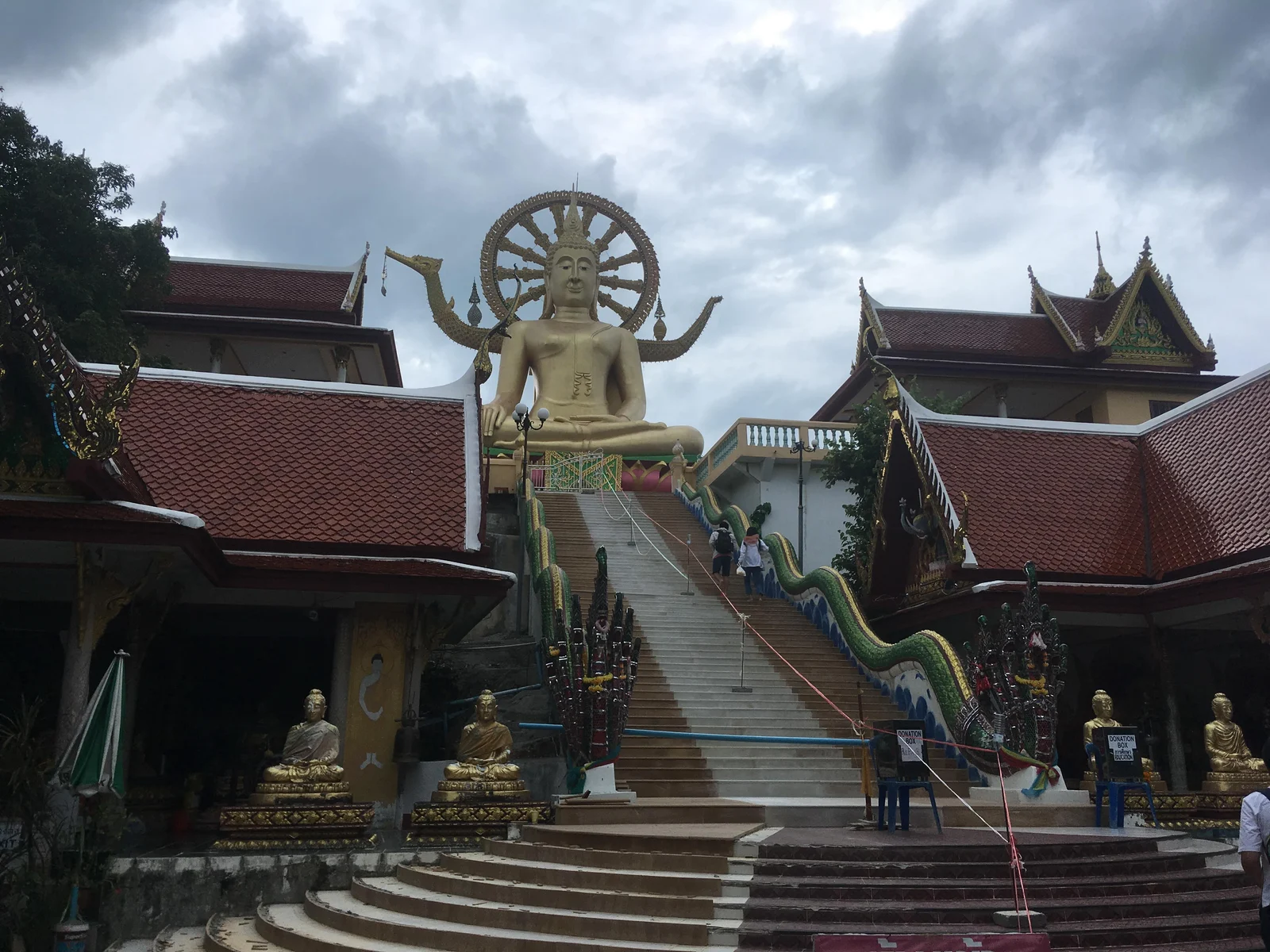
Big Buddha is Wat Phra Yai, on the small island of Ko Fan connected to Samui by land. The golden Buddha is about 39 feet tall, or 12 meters. Its position above the approach is part of the effect: the statue remains the visual center as you move toward the stairs. The staircase and terrace make this a vertically organized stop. The surrounding sea becomes more prominent once you reach the upper level, whereas a visit that stays below concentrates on the approach and the monument seen from ground level.
The upper terrace is the reason to choose this temple when a lookout matters as much as the religious setting. In clear conditions, the outlook extends toward Koh Phangan. Visibility and cloud cover affect that experience, so a hazy day changes the value of the view without removing the temple's main feature. The visit can still be worthwhile for the statue and staircase, but it is a weaker match for someone whose sole interest is photographing the distant coast.
The stairs also change the calculation for a group. A traveler with painful knees might enjoy seeing the Buddha from below while other people climb, but that divides the visit into two experiences. The lower approach is not an equivalent substitute for the terrace. For a family that wants to remain together, this distinction matters more than a claim that Big Buddha is a quick stop. Carrying a stroller upstairs would add a practical complication, and I would plan the outing around the people using it rather than assume the climb will work once everyone arrives.
A compact visit still needs a little room around it. Shoes may need to come off at marked religious areas, and the return to the vehicle takes time after the main photograph. Nearby souvenir shops can turn a brief stop into a longer pause, but shopping does not have to be part of the plan. A driver waiting at an agreed pickup point makes the length more flexible than a tour stop with a fixed departure. That flexibility is useful when one person wants to linger upstairs and another needs a rest.
A base near the northeast sights
Compare Koh Samui accommodation by its exact map position; a beach name alone does not show the final road approach.
Search places to stayWat Plai Laem offers more than the Guanyin photograph
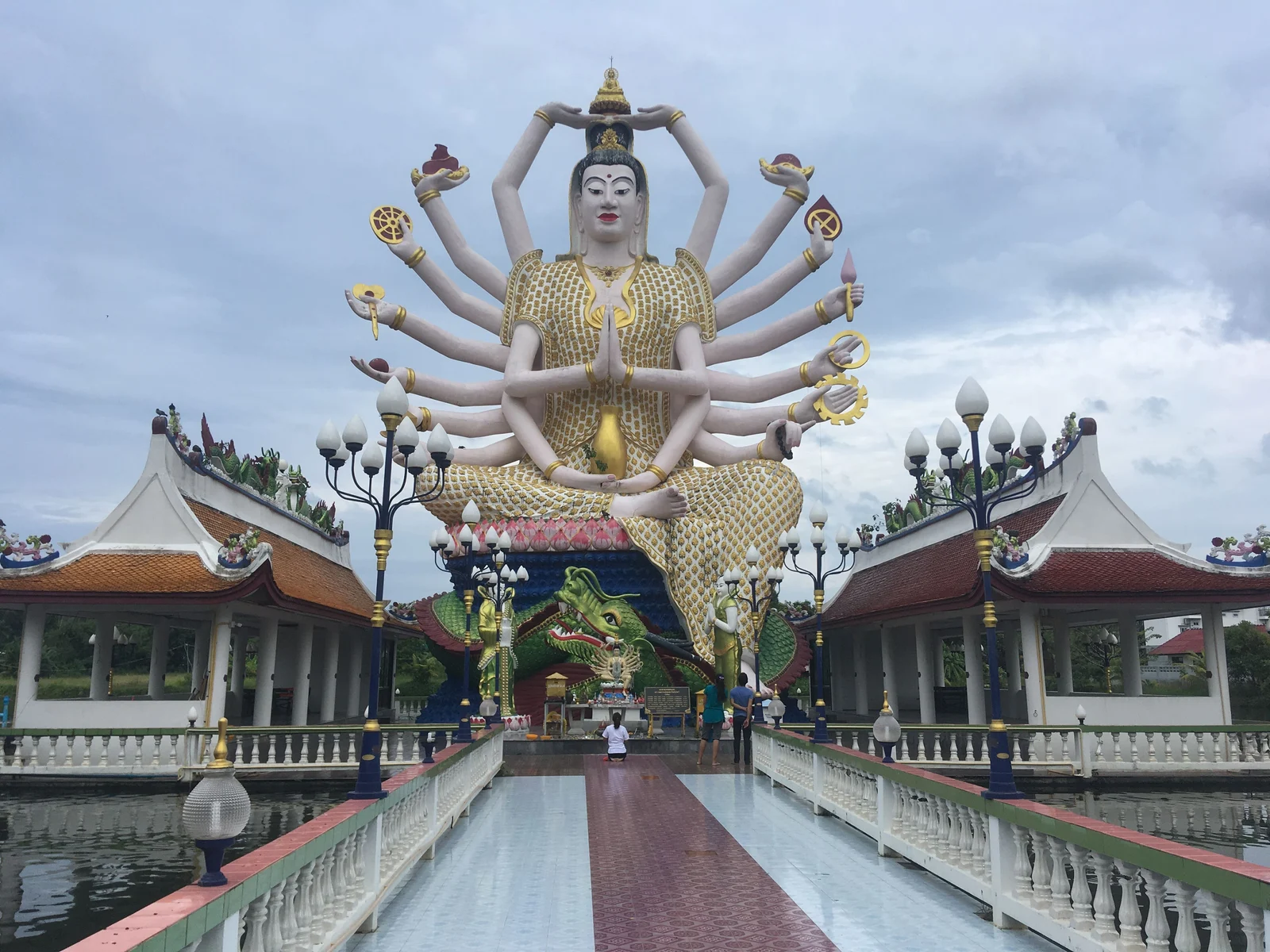
The many-armed Guanyin figure is the most distinctive subject at Wat Plai Laem. Its white-and-gold form rises above a platform reached across the water, with smaller structures framing the approach. The large Budai figure is a separate subject, so seeing the familiar Guanyin image online does not show the whole visit. Budai, often described in English as the Laughing Buddha, and Guanyin are different figures. Keeping those names separate makes the layout easier to understand and avoids treating every large statue as another version of Samui's Big Buddha.
Water gives the complex a different visual rhythm. A photograph from the approach includes the crossing and surrounding buildings; closer to a figure, the ornament and scale become more important. Reflections depend on the surface and light, rather than appearing reliably in every frame. Moving between viewpoints can be more absorbing than climbing to one lookout, especially for someone who enjoys comparing details. The Buddha footprint is another feature within the grounds, although the monumental figures are likely to hold most of a first-time visitor's attention.
Wat Plai Laem is my stronger choice for a traveler who likes exploring a site without making a summit the goal. That does not establish a step-free route. Crossing surfaces, thresholds and any access restrictions still matter to a wheelchair user, and a photograph of an open walkway cannot confirm accessible parking or every transition inside the grounds. The useful distinction is that the principal visual interest is spread around the lake instead of depending on the Big Buddha staircase. A companion can help assess the actual route from the drop-off before the group commits to circulating.
Photography here benefits from having time to wait for a clear view along a crossing. People using the shrines are part of an active temple, and a narrow approach has a purpose beyond framing the statue. A position off the main passage lets a photographer pause without holding up access. Close portraits of worshippers would be a different request from a wide architectural picture. For a visitor mainly interested in the buildings, the surrounding rooflines and the relationship between platforms offer subjects even when the central approach is busy.
How much of the day should the stop take?
For planning rather than as a promised visit duration, I would allow roughly half an hour to an hour inside either temple, with the road trip outside that allowance. A person who climbs, looks around and leaves may use the shorter end at Big Buddha. At Wat Plai Laem, time expands when you explore beyond the main Guanyin viewpoint. A longer visit is possible at either site; the practical reason for an allowance is to leave room for a stop that does not feel tied to the next appointment.
Big Buddha's listed visiting hours are 6 a.m. to 6 p.m. That makes a late-afternoon visit plausible, but a plan centered on remaining after dark would not fit the published window. There is no equally clear opening window on the Wat Plai Laem tourism listing used for this comparison, so this page does not assign it the same hours. A daylight outing gives you a workable starting point for either temple without building the day around an unconfirmed early opening or an assumed nighttime visit.
Morning can suit a day that continues elsewhere before lunch. Late afternoon fits a beach morning followed by a short land outing, though the available window narrows if you leave the hotel late. Neither choice guarantees an empty temple or flattering light. On a hot day, the exposed stairs and open platforms matter more than an ideal photography schedule. A midday outing may need a slower pace and a break in the vehicle. The morning versus late-afternoon comparison deals with placing the pair within a fuller day.
Hotel location changes the road trip, not the better temple
Bangrak, Plai Laem and Choeng Mon put these sights in the same broad part of the island as your stay. That can make one temple a small outing between beach time and an evening meal. A hotel's actual entrance matters, especially when a property is set back from the main road or reached along a hillside approach. Being geographically close does not establish an easy walk: a short map line says nothing about shade, sidewalks or comfortable crossings. A car ride can be sensible even when the distance looks modest on a phone.
From a hotel farther south or on the west coast, the transport commitment becomes a larger part of the choice. Dropping the second temple saves its visiting time but does not remove the journey to the northeast. In that situation, the decision is whether one sight justifies that outing at all. A family heading this way for another reason may find a temple stop fits naturally. Someone making a dedicated return trip from a distant resort may prefer to combine both, or reserve the sightseeing time for a different part of the island.
A private driver is useful when the return time is uncertain or the outing includes several stops. For a single temple, separate rides can work if the pickup location and return arrangement are clear. The booking needs the exact temple name: Wat Phra Yai and Wat Plai Laem are not interchangeable destinations. A round-trip quote with waiting time means something different from two one-way fares. The private driver versus taxis guide is the relevant comparison; no fixed fare is assumed here.
I would not change hotels to shorten one temple visit. The daily beach and dinner routine has more opportunities to affect the stay. Plai Laem versus Bangrak is useful when you are weighing the northeast base itself, while Plai Laem versus Choeng Mon compares two nearby areas with different accommodation settings. The temple decision becomes easier once that larger accommodation choice is settled.
Compare the base for the whole stay
Search across Koh Samui to compare your preferred beach area with the location of the temples.
Search places to stayClothing and small costs that affect a beach-day visit
Covered shoulders and clothing that covers the knees make a temple outing easier to combine with a beach day. A light layer can handle the change from resort clothing without requiring a return to the room, provided the rest of the outfit is suitable too. Shoe-removal signs define where footwear comes off; slip-on shoes are useful at those transitions. Socks may be more comfortable on warm surfaces, although a wet day creates a different problem. These details affect the visit more directly than packing special equipment for a short sightseeing stop.
Watching a shrine from the edge does not require joining the ritual. Anyone who wants to make an offering can follow the arrangement at that particular shrine. Women should avoid direct contact with monks or their robes, including when handing something over. Sitting with feet directed away from a Buddha image is part of ordinary temple etiquette. Those customs apply at both sites, so choosing one does not eliminate the need for suitable clothing or change the basic way the religious areas are used.
Wat Plai Laem's tourism listing describes admission as free. That is separate from any voluntary donation, offering or purchase made during a visit. This comparison does not attach an unverified entrance price to Big Buddha. For a short excursion, the vehicle arrangement is the cost worth resolving in advance, especially if it includes waiting. A little cash is useful for optional purchases, but treating donations as an obligatory ticket would confuse two different things. Time spent arranging the ride is often more important to the outing than the spending inside the grounds.
When the pair is the better plan
Both temples make sense when the contrast is what interests you: Big Buddha's raised sea-facing terrace followed by Wat Plai Laem's lake setting. Their proximity makes that a coherent northeast outing, without requiring a whole-island circuit. The second visit earns its time through a different layout rather than simply adding another name to the itinerary. The independent visit versus tour guide helps with the next question if you want interpretation or organized transport for that pair.
For a group split between cultural sightseeing and a beach afternoon, one stop may still be the better agreement. The person choosing can identify the feature that justifies leaving the hotel, while the return plan keeps the outing bounded. If the wider choice is between the northeast temples and a day elsewhere, the temples versus south-island nature comparison addresses that decision. It is a different scale of trip from deciding which temple to see during an already planned drive.
Sources and photograph credits
Fact check: October 12, 2026. Primary references: Tourism Authority of Thailand, The Big Buddha (Phra Yai) (Ko Fan, 12-meter figure, staircase, terrace and 06:00–18:00 listing); Wat Plai Laem (Guanyin, Budai, water setting, Buddha footprint and free admission); temple etiquette. The visit allowances and transport comparisons are editorial planning judgments, not operator timetables. No unconfirmed Wat Plai Laem opening hours or Big Buddha admission charge are quoted.
Big Buddha photograph: Wat Phra Yai 02.jpg, own work by Christophe95, licensed CC BY-SA 4.0. Original file. The Commons description identifies Wat Phra Yai in northern Ko Samui; the photographed subject is the golden Buddha above the main staircase. Capture: June 10, 2018, 16:18:47, as recorded in the Commons summary and matching original EXIF (timezone unspecified). Upload: November 24, 2019, not the capture date.
Wat Plai Laem photograph: Wat Plai Laem 02.jpg, own work by Christophe95, licensed CC BY-SA 4.0. Original file. The Commons description identifies the Guanyin statue at Wat Plai Laem in northern Ko Samui; the photograph shows that figure and its approach across the water. Capture: June 10, 2018, 16:34:26, as recorded in the Commons summary and matching original EXIF (timezone unspecified). Upload: November 27, 2019, not the capture date.
Adaptations for both photographs: auto-orientation, reduction from 4032 × 3024 to 1600 × 1200, and WebP compression. Each 320 × 200 thumbnail is center-cropped and WebP-compressed; the responsive gallery also crops the displayed image to its frame. No objects were added or removed and no color edits were applied. The local image adaptations remain under CC BY-SA 4.0. These older photographs identify the sites; they do not document current access arrangements.