
Four friends can make a Chiang Mai hotel work like a base camp or a small part of the vacation. If most of your time is already spoken for by temples, markets and dinners around town, an interconnecting pair at Shangri-La Chiang Mai gives everyone a proper bed and a door between rooms without turning the hotel into the main event.
If you expect slow mornings, pool afternoons and a drink together before dinner, Horizon Club access may matter more than the connecting door—but only if the lounge hours fit the way your group travels.
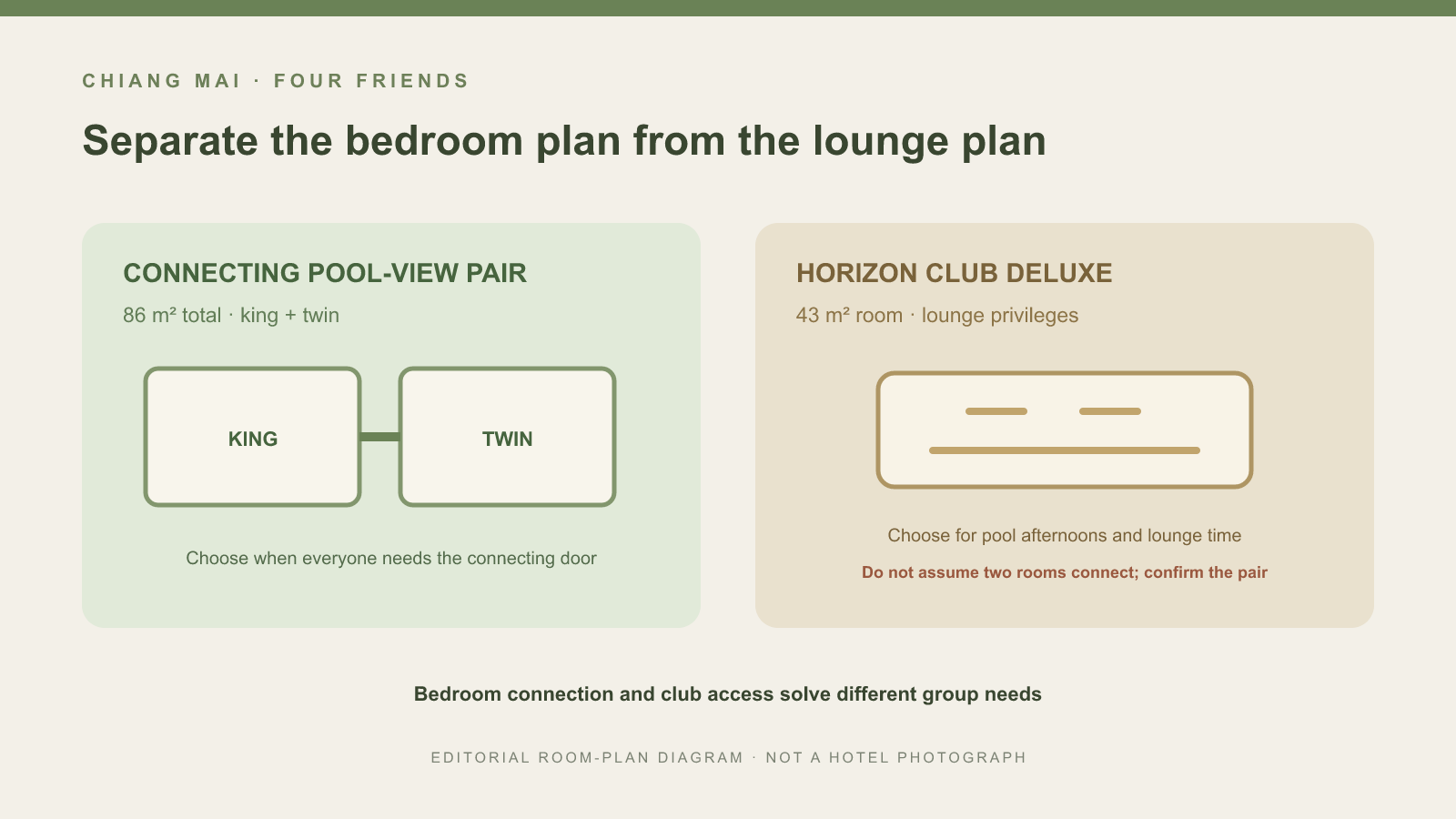
The distinction is easy to blur on a booking screen. The hotel lists an 86-square-meter Two Deluxe Pool View Rooms Connecting category made from a king room and a twin room. Separately, Horizon Club Deluxe is a 43-square-meter room with lounge privileges.
The public room information does not say that two Horizon Club rooms can be connected, so I would not pay for the club category assuming that the friends can move freely between their bedrooms. Ask the hotel to confirm the exact room pair in writing before treating adjoining doors as part of that plan.
Four friends · two sleep setups
Compare both plans for the same dates
Use four adults and the same dates for each search. Check that the connecting-room request is confirmed, then compare the total against two club rooms with lounge access.
The connecting pair solves the bedroom question cleanly
The strongest argument for the connecting category is not its view. It is the layout. The hotel describes two interconnecting rooms with a combined area of 86 square meters: one Deluxe King and one Deluxe Twin.
Four friends can assign two people to each room, close the connecting door when somebody wants quiet, and open it again when the group is choosing a ride or deciding where to eat. You get two actual bedrooms rather than one large room where bags, getting-ready routines and late-night conversations all compete for the same floor space.
The King-and-Twin split is unusually useful for a mixed group. Two friends who already share a bed can take the king room; the other two each have a separate twin. If everybody wants an individual bed, the pair does not provide that. A rollaway is not a detail I would assume from the room label, and the public description does not promise one. Ask the hotel to confirm the allowed adult count, bed dimensions and any extra-bed option for your exact dates before making the split-payment plan.
“Connecting” is also more specific than “nearby.” When the booking is confirmed as the named connecting category, the interior door is the social hinge: friends can borrow sunscreen, talk through the day, or meet without coordinating elevator rides.
If you book two ordinary rooms and leave a note asking for them beside each other, the hotel may be able to help, but that is not the same guarantee. I would preserve the named category in the confirmation and follow up if the reservation summary drops the word connecting.
The compromise is that neither room is a shared living room. There is no separate lounge where four people can spread out while both bedrooms stay private. If your ideal evening includes a long card game, a bottle of wine and four people lingering around one table, the connecting pair may feel like two bedrooms joined at the doorway rather than a group suite. In that case, the hotel’s public spaces need to do the social work.
Horizon Club buys a scheduled social window, not a bigger room
A Horizon Club Deluxe room is 43 square meters, half the published combined area of the connecting pair. Its case is the lounge access: the hotel’s room information lists daily breakfast and evening cocktails among the benefits.
A current club-and-suite offer spells out a 5:30–7:30 p.m. happy hour, plus coffee, tea and soft drinks through the day. Because benefits can vary by rate and date, I would verify what the selected room offer actually includes rather than assume a campaign’s terms apply to every booking.
For four friends, that evening window can change the rhythm. Meet upstairs for a first drink, decide whether to dine in or go out, and let the group that wants a second round stay while an early sleeper heads back.
Breakfast is another useful shared appointment: nobody has to find a café on the first morning while the group is still shaking off travel. The club option is most persuasive when at least a couple of you will use those windows on most days.
If you are leaving early and returning after the lounge closes, the extra access is mostly theoretical.
Do not confuse lounge benefits with the hotel’s public Lobby Lounge. The Lobby Lounge separately lists cocktails, afternoon tea, light dining and daily happy hour from 5 to 7 p.m.
That is a convenient meeting spot whether or not you stay in a club room; the room category determines whether breakfast and the Horizon Club’s own service are part of your stay. If your group mainly wants somewhere attractive to meet for a drink, the public lounge may cover that desire without upgrading all four guests.
The pool gives either plan a more relaxed fallback. Shangri-La describes an expansive free-form pool and its main property page promotes a waterslide and splash zone.
That makes the hotel more appealing to friends who want a resort-style pause between city outings, even though the connecting room itself does not promise a private terrace or direct pool access.
I would treat the pool as shared property entertainment, not as a reason to expect an empty deck or a private cabana; those are separate availability questions.
Make the upgrade survive the group chat
Room decisions for friends often go sideways after someone finds a perk one person loves and the other three barely use. Horizon Club is a clear example.
If two of you wake early, eat breakfast at the hotel and want a drink before dinner, while the other two prefer coffee outside and stay out until late, the lounge may be valuable to one pair and irrelevant to the other.
That does not make the club room a bad choice; it means the group should compare what each room includes against the habits of the people paying for it.
I would put the room total in the group chat with the same guest count and dates, then ask one practical question: which plan would make us change our day? A confirmed connecting door changes where people meet and how easily they share small things. Club access changes where breakfast happens and whether a pre-dinner drink is already built into the hotel routine. If nobody expects to use the lounge twice on a typical full day, the connection itself is probably the more durable benefit.
There is also a social difference between a lounge and a bar. The Horizon Club is useful for a quiet drink and a conversation before the city gets busy; it is not a nightlife venue. If the group wants music, a longer cocktail menu or a reason to dress up, decide where you will go after the first round.
The hotel's Lobby Lounge and nearby Chang Klan venues can anchor that evening without asking everyone to stay upstairs. I would value the club most for the softer parts of the trip: breakfast when plans are loose, a pause after shopping, or the moment when four people need to settle on dinner without opening four separate maps.
The connecting category has its own compromise. An internal door does not turn the two rooms into a suite, and a pool view is not a private pool. If one friend tends to go to bed early, agree on the door etiquette before the first night.
If you plan to leave it open, remember that sound travels between the rooms; if you close it, the group still needs to message or knock. That sounds small, but it is exactly the sort of small arrangement that makes a four-person stay feel easy instead of slightly improvised.
Let the neighborhood decide how much hotel time you need
Shangri-La sits on Chang Klan Road, with the Night Bazaar, the Old City and transport links all within reach. That is a useful urban-resort balance: the hotel has enough space and facilities to hold a low-key day, while the group can still head out for a market dinner or a temple visit without choosing a remote mountain retreat. The exact trip to each stop changes with traffic, weather and the group’s appetite for walking, so I would not build the plan around a single map estimate.
For a three-night visit, I would use the connecting pair as the dependable base and let the city supply the evenings. One night can be a relaxed meal at the hotel; another can start with a drink at the Lobby Lounge and continue at the Night Bazaar; a third can be left flexible.
Horizon Club has more pull if the group expects to be back for cocktails before dinner and values breakfast on property. If the nights will run late outside the hotel, the club’s most social benefit may happen while everyone is somewhere else.
The resort facilities matter most on the day when Chiang Mai’s heat or rain knocks the ambitious itinerary sideways. A generous pool, food nearby and a room pair with a door between them gives the group a simple reset plan. By contrast, friends who plan sunrise excursions and long days in the Old City should spend more attention on how easy it is to get moving, not on how many hours the hotel can keep them entertained.
If the location itself is still undecided, compare the hotel base with the city-side options in riverside resort vs. central Chiang Mai. If the hotel is already set, use the shuttle-versus-walk-out location guide to decide how often your group wants to arrange transport. Those choices will shape your days more than whether the room view catches the pool or the mountains.
Check the room type, then the extras
See what is actually included for your stay
Compare a confirmed king-and-twin connection with two club rooms. Keep the guest count identical and verify lounge access before you weigh the totals.
Which friends should choose each plan?
Pick the connecting pair when four people want two proper bedrooms, one king-and-twin allocation suits the group, and you value a door between rooms more than an included cocktail hour. It keeps the room decision legible: two beds in one room, a king in the other, one pool-facing setting and no promise of a separate lounge that the room description does not list.
Look at Horizon Club rooms when your group is comfortable with separate rooms that may not connect and will reliably use breakfast or evening drinks. The lounge can make arrivals and pre-dinner decisions easier, but it is not a private living room for your party. Confirm the total guests allowed in each room and whether the specific offer includes the hours and meals you care about.
Choose a suite or another layout if the four of you want a real living room as the center of the stay, or if each person needs a separate bed. Shangri-La’s larger suites are a different category; their published descriptions should be checked for bedroom count and bed setup rather than assumed to sleep four adults simply because the lounge can host visitors. Ask for the room plan and the adult occupancy for the exact suite name.
For the connecting option, the key confirmation is simple: the booking must name the two Deluxe Pool View Rooms Connecting, and the hotel must confirm the four-adult arrangement. For the club option, ask which lounge privileges apply to the quoted rate and whether the rooms can be placed together. With those answers, your group can make the decision around the part of the trip you will actually share—sleeping arrangements, mornings, pool time or the first drink before dinner.
Shangri-La Chiang Mai for a four-friend stay
These scores reflect the connecting-room setup, hotel facilities and Chang Klan base described above.
Two rooms join through an internal door, giving each pair a bedroom to close off.
The named pair combines one king room and one twin room; it suits two pairs, not four solo-bed requests.
The connecting door helps coordination, but the category does not list a separate shared living room.
The hotel promotes its large free-form pool, water slide and splash area as shared resort facilities.
Horizon Club cocktails and the separate Lobby Lounge give the group low-friction meet-up options.
Chang Klan puts the Night Bazaar nearby and leaves Old City outings within practical reach.
My pick: start with the connecting pool-view pair if bedroom privacy is the non-negotiable. Choose Horizon Club only when your group’s schedule will bring you back for its breakfast or evening window—and confirm room placement before you pay for the upgrade.
Shangri-La Chiang Mai · four adults
Check the confirmed room plan
Run your actual dates and four-adult guest count, then confirm the connecting door or club access directly in the selected room details.
Sources checked
- Two Deluxe Pool View Rooms Connecting — combined area, interconnecting configuration and King/Twin layout.
- Horizon Club Deluxe — room size and club access.
- Club and Suite offer details — current published lounge benefits; package terms may vary.
- The Lobby Lounge — public lounge hours and happy hour.
- Shangri-La Chiang Mai — property location, pool and facilities.
- Iron Bridge in Chiang Mai — Christophe95, CC BY-SA 4.0.
- Tha Phae Gate, Chiang Mai — shankar s., CC BY 2.0.
Checked 6 October 2026. Hotel-room media is intentionally excluded because commercial reuse permission for this exact room category could not be verified.